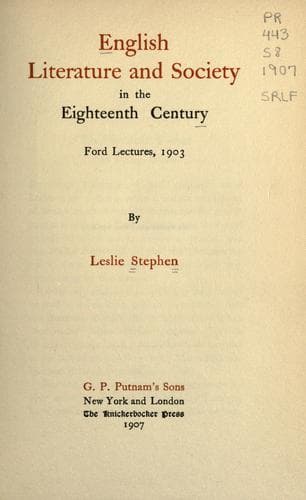
English Literature and Society in the Eighteenth Century — John Shaqi
English Literature and Society in the Eighteenth CenturyStephen, Leslie
History
English Literature and Society in the Eighteenth Century
Stephen, Leslie
England -- Social life and customs -- 18th century; English literature -- 18th century -- History and criticism
This is the phenomenon which we have to consider;--let us listen for a
moment to the 'distinguished critics' who have denounced or defended the
comedy of the time. Macaulay gives as a test of the morality of the
Restoration stage that on it, for the first time, marriage becomes the
topic of ridicule. We are supposed to sympathise with the adulterer, not
with the deceived husband--a fault, he says, which stains no play
written before the Civil War. Addison had already suggested this test in
the _Spectator_, and proceeds to lament that 'the multitudes are shut
out from this noble "diversion" by the immorality of the lessons
inculcated.' Lamb, indulging in ingenious paradox, admires Congreve for
'excluding from his scenes (with one exception) any pretensions to
goodness or good feeling whatever.' Congreve, he says, spreads a
'privation of moral light' over his characters, and therefore we can
admire them without compunction. We are in an artificial world where we
can drop our moral prejudices for the time being. Hazlitt more daringly
takes a different position and asserts that one of Wycherly's coarsest
plays is 'worth ten sermons'--which perhaps does not imply with him any
high estimate of moral efficacy. There is, however, this much of truth,
I take it, in Hazlitt's contention. Lamb's theory of the non-morality of
the dramatic world will not stand examination. The comedy was in one
sense thoroughly 'realistic'; and I am inclined to say, that in that lay
its chief merit. There is some value in any truthful representation,
even of vice and brutality. There would certainly be no difficulty in
finding flesh and blood originals for the rakes and the fine ladies in
the memoirs of Grammont or the diaries of Pepys. The moral atmosphere is
precisely that of the dissolute court of Charles II., and the 'privation
of moral light' required is a delicate way of expressing its
characteristic feeling. In the worst performances we have not got to any
unreal region, but are breathing for the time the atmosphere of the
lowest resorts, where reference to pure or generous sentiment would
undoubtedly have been received with a guffaw, and coarse cynicism be
regarded as the only form of comic insight. At any rate the audiences
for which Congreve wrote had just so much of the old leaven that we can
quite understand why they were regarded as wicked by a majority of the
middle classes. The doctrine that all playgoing was wicked was naturally
confirmed, and the dramatists retorted by ridiculing all that their
enemies thought respectable. Congreve was, I fancy, a man of better
morality than his characters, only forced to pander to the tastes of the
rake who had composed the dominant element of his audience. He writes
not for mere blackguards, but for the fine gentleman, who affects
premature knowledge of the world, professes to be more cynical than he
really is, and shows his acuteness by deriding hypocrisy and pharisaic
humbug in every claim to virtue.
Public-domain text, read in full here on John Shaqi.
Reviews
Reviews
No reviews yet
Be the first to share your thoughts on this work.
Join the Discussion
Join the discussion
Sign in to leave a comment or review.
Sign InorCreate an account