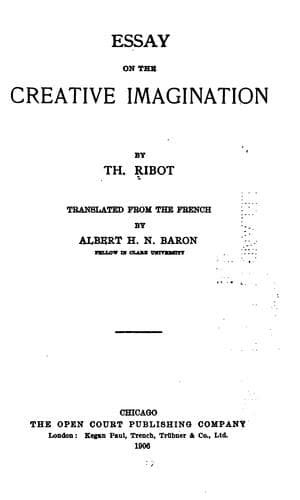
Essay on the Creative ImaginationRibot, Th. (Théodule)
Science
Essay on the Creative Imagination
Ribot, Th. (Théodule)
Creation (Literary, artistic, etc.); Imagination
A serious argument in favor of the prevalence of imagination of the
motor type in the child is furnished by the principal part taken by
movements in infantile insanity: a remark made by many alienists. The
first stage of this madness, they say, is found in the convulsions that
are not merely a physical ailment, but "a muscular delirium." The
disturbance of the automatic and instinctive functions of the child is
so often associated with muscular disturbances that at this age the
mental disorders correspond to the motor ganglionic centers situated
below those parts that later assume the labor of analysis and of
imagination. The disturbances are in the primary centers of organization
and according to the symptoms lack those analytic or constructive
qualities, those ideal forms, that we find in adult insanity. If we
descend to the lowest stage of human life--to the baby--we see that
insanity consists almost entirely of the activity of a muscular group
acting on external objects. The insane baby bites, kicks, and these
symptoms are the external measure of the degree of its madness.[39] Has
not chorea itself been called a muscular insanity?
Doubtless, there likewise exists in the child a sensorial madness
(illusions, hallucinations); but by reason of its feeble intellectual
development the delirium causes a disorder of movements rather than of
images; its insane imagination is above all a motor insanity.
To hold that the creative imagination belonging to animals consists of
new combinations of movements is certainly an hypothesis. Nevertheless,
I do not believe that it is merely a mental form without foundation, if
we take into account the foregoing facts. I consider it rather as a
point in favor of the motor theory of invention. It is a singular
instance in which the original form of creation is shown bare. If we
wanted to discover it, it would be necessary to seek it where it is
reduced to the greatest simplicity--in the animal world.
FOOTNOTES:
[35] Chapter X.
[36] _Op. cit._, Appendix.
[37] For a more detailed study of this subject, the reader is
referred to the author's _Evolution of General Ideas_ (English
trans., Open Court Publishing Co., Chicago), chapter I, section I.
[38] A rather extended study of the subject by H. A. Carr will be
found in the _Investigations of the Department of Psychology and
Education of the University of Colorado_, vol. I, Number 2, 1902.
The late Professor Arthur Allin devoted much time to the
investigation of play. See his brief article entitled "Play" in the
_University of Colorado Studies_, vol. I, 1902, pp. 58-73. (Tr.)
[39] Hack Tuke, "Insanity of Children," in _Dictionary of
Psychological Medicine_.
CHAPTER II
THE CREATIVE IMAGINATION IN THE CHILD
Public-domain text, read in full here on John Shaqi.
Reviews
Reviews
No reviews yet
Be the first to share your thoughts on this work.
Join the Discussion
Join the discussion
Sign in to leave a comment or review.
Sign InorCreate an account