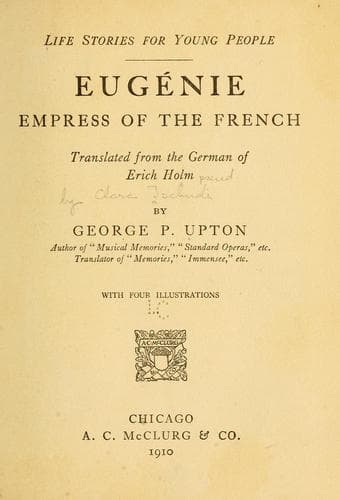
Eugénie, Empress, consort of Napoleon III, Emperor of the French, 1826-1920; Napoleon III, Emperor of the French, 1808-1873 -- Marriage
Like all the children of Spain, she had the deepest affection and
reverence for her native land, that land with which were connected so
many happy as well as painful memories, and where her mother still
lived. Now that her griefs had lost their sting, she often longed for
Spanish ways and customs and to hear once more her childhood’s tongue.
From Biarritz she could make frequent excursions into Spain, where she
hailed even the poorest peasants with delight, chatting with them in
their native language, overwhelming them with gifts, and receiving in
return so warm a welcome that it more than repaid her for all the
humiliations of her youth. She also visited Madrid, the scene of her
early adventures, and was received with the greatest distinction by
Queen Isabella, from whose court she had once been dismissed on so
slight a suspicion.
But it was not only in Spain that Eugénie won all hearts. Whether
receiving royal guests or visiting some charitable institution,
presiding at court or opening an exhibition, it could not be denied that
she had been wonderfully equipped by nature for the great role she had
been called upon to play on the world’s stage. Part of her popularity
was also due to the kindness of heart which was such a conspicuous trait
in her character through all her changes of fortune. Many admirable
institutions in Paris owe their origin to the Empress Eugénie’s
benevolence. In the Summer of 1865, while acting as Regent during the
Emperor’s stay in Algiers, she devoted herself to improving conditions
in the reform schools for children. Accompanied by a prefect of police
she made a visit in person to “La Petite Roquette,” a house of
correction. A terrible state of affairs existed in this institution,
where, since it was intended more for abandoned children than those in
need of punishment, a cell system had been introduced to prevent
communication between the two classes. The dark court was also divided
by high walls; and here the five hundred wretched inmates could be seen
creeping about their cages like wild beasts, with bowed heads and dull,
vacant faces.
The Empress’s motherly heart overflowed with pity at sight of these
children’s sufferings. She appointed a commission at once to make a
change in this dreadful system and attended all the meetings, which were
held at the Tuileries, with the greatest interest and enthusiasm. A
member of the commission took advantage of one of these meetings to
oppose the Empress’s project. “The idea is all very well, Madame,” he
declared, “but there are so many obstacles in the way of its execution
that it is difficult to see how any remedy can be provided. To discuss
the question is merely an excursion into the realm of sentiment.”
Public-domain text, read in full here on John Shaqi.
Reviews
Reviews
No reviews yet
Be the first to share your thoughts on this work.
Join the Discussion
Join the discussion
Sign in to leave a comment or review.
Sign InorCreate an account