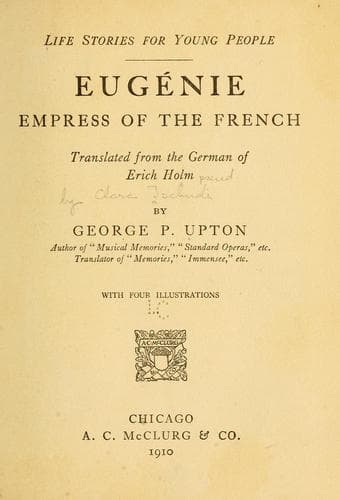
Eugénie, Empress, consort of Napoleon III, Emperor of the French, 1826-1920; Napoleon III, Emperor of the French, 1808-1873 -- Marriage
“Pardon me,” replied the Empress gently, “but this is a question of
humanity, not of politics.” And she finally carried her point. The
youthful prisoners of La Roquette were sent into the country, and the
cell system was abolished. It was not without anxiety that the warders
received the new inmates, fearing it would be a hard task to manage them
and that the well-behaved children would be corrupted by the others.
Results proved, however, that the Empress was right, for even the most
depraved and hardened culprits improved with kind treatment and work in
the open air.
Equally worthy of note was the day spent by the Regent at St. Lazare—a
place of confinement for abandoned women. News of the Empress’s visit to
this place spread like wildfire over the city, and on leaving these
poor, despised creatures she received touching proofs of the people’s
devotion to her. The crowds assembled in the streets murmured blessings
on her, while the women knelt to kiss the hem of her gown.
Toward the end of September, 1865, cholera broke out in Paris, and the
court, which was then at Biarritz, decided to return to the capital at
once. The memory of the terrible epidemic of 1849 was still fresh in the
minds of the people; and when, after apparently subsiding, the disease
broke out again with renewed violence a terrible panic ensued. The
courage and self-sacrifice displayed by Eugénie during this time won
universal applause; the newspapers, even those hostile to her, were loud
in praise of the royal “sister of charity.” On the twenty-first of
October the Emperor made a long visit to one of the cholera hospitals,
and on leaving ordered the sum of fifty thousand francs to be
distributed for the relief of the sufferers. Eugénie, to whom he had
said nothing of his intention, was much disappointed at not having
accompanied him. The next morning she drove from St. Cloud to Paris,
where she made the rounds of all the cholera hospitals herself, going
from bed to bed with words of cheer and comfort. Once, pausing beside a
man who was dying, she took his hand in hers gently and spoke some words
of sympathy to him. Thinking it one of the nuns, the poor fellow
summoned up his last remnants of strength to kiss her hand. “Thanks,
sister,” he murmured. The sister of charity who accompanied the Empress
leaned over and said:
“You mistake, my friend; it was not I, but our gracious Empress who
spoke to you.”
“Never mind, sister,” interposed Eugénie, “he could have given me no
more beautiful name—” a saying which was repeated and long remembered
among the people.
* * * * * * * *
Public-domain text, read in full here on John Shaqi.
Reviews
Reviews
No reviews yet
Be the first to share your thoughts on this work.
Join the Discussion
Join the discussion
Sign in to leave a comment or review.
Sign InorCreate an account