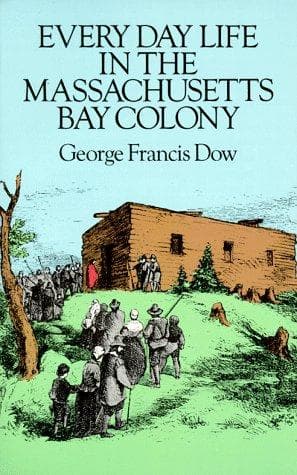
Every Day Life in the Massachusetts Bay ColonyDow, George Francis
History
Every Day Life in the Massachusetts Bay Colony
Dow, George Francis
Massachusetts -- Social life and customs -- To 1775
The only type of log construction in use in New England in the early
days existed in garrison houses built as a protection against the
Indians. In every instance the logs were carefully hewed square,
to make a close fit against each other, and never notched at the
ends, sometimes halved at the corners of the structure, but usually
dove-tailed into each other at the ends in medieval military manner.
Several of these garrison houses still exist and although afterwards
used as dwellings, at first they were built as forts.
What happened at the Plymouth Colony after the _Mayflower_ came
to anchor? The wind blew very hard for two days and the next day,
Saturday, December 23, 1620, as many as could went ashore: "felled
and carried timber, to provide themselves stuff for building,"
and the following Monday "we went on shore, some to fell timber,
some to saw, some to rive, and some to carry; so no man rested all
that day."[12] Bradford writes "that they builte a forte with good
timber" which Isaac de Rasieres described in 1627 as "a large square
house, made of thick sawn planks, stayed with oak beams." The oldest
existing houses in the Plymouth Colony are built in the same manner
and some half dozen or more seventeenth-century plank houses may yet
be seen north of Boston. Moreover, when the ship _Fortune_ sailed
from Plymouth in the summer of 1621, the larger part of her lading
consisted of "clapboards and wainscott," showing clearly that the
colonists soon after landing had dug saw pits and produced boards in
quantity suitable for the construction of houses and for exportation.
[12] _Mourt's Relation_, Boston, 1841.
The first settlers in the Massachusetts Bay brought with them
mechanics of all kinds, well equipped with tools, and it is
altogether probable that these workmen plied their trades on this
side of the Atlantic exactly as they had been taught through long
centuries of apprenticeship in England. The houses of that early
period, still remaining, all resemble similar English structures.
Upon arrival, however, the need for shelter was imperative, and
all sorts of rude expedients were adopted. Deacon Bartholomew
Green, the printer of the _Boston News-Letter_, related that when
his father arrived at Boston in 1630, "for lack of housing he was
wont to find shelter at night in an empty cask," and during the
following winter many of the poorer sort still continued to live in
tents through lack of better housing. When Roger Clap arrived at
Charlestown in 1630 he "found some Wigwams and one House ... in the
meantime before they could build at Boston, they lived many of them
in tents and Wigwams."
Public-domain text, read in full here on John Shaqi.
Reviews
Reviews
No reviews yet
Be the first to share your thoughts on this work.
Join the Discussion
Join the discussion
Sign in to leave a comment or review.
Sign InorCreate an account