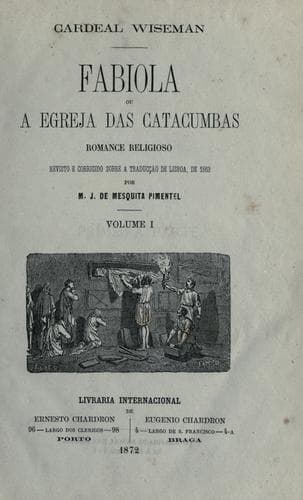
Fabiola; Or, The Church of the Catacombs — John Shaqi
Fabiola; Or, The Church of the CatacombsWiseman, Nicholas Patrick
HistoryHistory
Fabiola; Or, The Church of the Catacombs
Wiseman, Nicholas Patrick
Christian fiction; Church history -- Primitive and early church, ca. 30-600 -- Fiction; Historical fiction
“How delighted I should be, most noble mistress,” said the black slave,
“if I could only be in the triclinium[16] this evening as you enter in,
to observe the brilliant effect of this new stibium[17] on your guests!
It has cost me many trials before I could obtain it so perfect: I am
sure nothing like it has been ever seen in Rome.”
“As for me,” interrupted the wily Greek, “I should not presume to aspire
to so high an honor. I should be satisfied to look from outside the
door, and see the magnificent effect of this wonderful silk tunic, which
came with the last remittance of gold from Asia. Nothing can equal its
beauty; nor, I may add, is its arrangement, the result of my study,
unworthy of the materials.”
“And you, Syra,” interposed the mistress, with a contemptuous smile,
“what would you desire? and what have you to praise of your own doing?”
“Nothing to desire, noble lady, but that you may be ever happy; nothing
to praise of my own doing, for I am not conscious of having done more
than my duty,” was the modest and sincere reply.
It did not please the haughty lady, who said, “Methinks, slave, that you
are not over given to praise. One seldom hears a soft word from your
mouth.”
“And what worth would it be from me,” answered Syra; “from a poor
servant to a noble dame, accustomed to hear it all day long from
eloquent and polished lips? Do you believe it when you hear it from
_them_? Do you not despise it when you receive it from _us_?”
A look of spite was darted at her from her two companions. Fabiola, too,
was angry at what she thought a reproof. A lofty sentiment in a slave!
“Have you yet to learn, then,” she answered haughtily, “that you are
mine, and have been bought by me at a high price, that you might serve
me as _I_ please? I have as good a right to the service of your tongue
as of your arms; and if it please me to be praised, and flattered, and
sung to, by you, do it you shall, whether _you_ like it or not. A new
idea, indeed, that a slave has to have any will but that of her
mistress, when her very life belongs to her!”
“True,” replied the handmaid, calmly but with dignity, “my life belongs
to you, and so does all else that ends with life,--time, health, vigor,
body, and breath. All this you have bought with your gold, and it has
become your property. But I still hold as my own what no emperor’s
wealth can purchase, no chains of slavery fetter, no limit of life
contain.”
“And pray what is that?”
“A soul.”
“A soul!” re-echoed the astonished Fabiola, who had never before heard a
slave claim ownership of such a property. “And pray, let me ask you,
what you mean by the word?”
Public-domain text, read in full here on John Shaqi.
Reviews
Reviews
No reviews yet
Be the first to share your thoughts on this work.
Join the Discussion
Join the discussion
Sign in to leave a comment or review.
Sign InorCreate an account