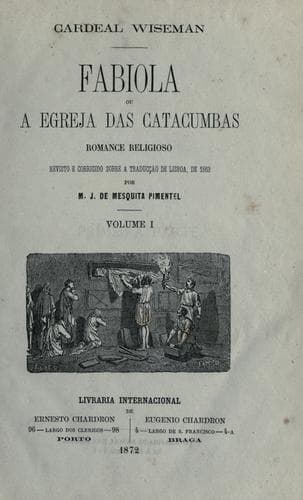
Fabiola; Or, The Church of the CatacombsWiseman, Nicholas Patrick
HistoryHistory
Fabiola; Or, The Church of the Catacombs
Wiseman, Nicholas Patrick
Christian fiction; Church history -- Primitive and early church, ca. 30-600 -- Fiction; Historical fiction
“I cannot speak philosophical sentences,” answered the servant, “but I
mean that inward living consciousness within me, which makes me feel to
have an existence with, and among, better things than surround me, which
shrinks sensitively from destruction, and instinctively from what is
allied to it, as disease is to death. And therefore it abhors all
flattery, and it detests a lie. While I possess that unseen gift, and
die it cannot, either is impossible to me.”
The other two could understand but little of all this; so they stood in
stupid amazement at the presumption of their companion. Fabiola too was
startled; but her pride soon rose again, and she spoke with visible
impatience.
“Where did you learn all this folly? Who has taught you to prate in this
manner? For my part, I have studied for many years, and have come to the
conclusion, that all ideas of spiritual existences are the dreams of
poets, or sophists; and as such I despise them. Do you, an ignorant,
uneducated slave, pretend to know better than your mistress? Or do you
really fancy, that when, after death, your corpse will be thrown on the
heap of slaves who have drunk themselves, or have been scourged, to
death, to be burnt in one ignominious pile, and when the mingled ashes
have been buried in a common pit, _you_ will survive as a conscious
being, and have still a life of joy and freedom to be lived?”
“‘_Non omnis moriar_,’[18] as one of your poets says,” replied
[Illustration: “Fabiola grasped the style in her right hand, and made an
almost blind thrust at the unflinching handmaid.”]
modestly, but with a fervent look that astonished her mistress, the
foreign slave; “yes, I hope, nay, I _intend_ to survive all this. And
more yet; I believe, and know, that out of that charnel-pit which you
have so vividly described, there is a hand that will pick out each
charred fragment of my frame. And there is a power that will call to
reckoning the four winds of heaven, and make each give back every grain
of my dust that it has scattered; and I shall be built up once more in
this my body, not as yours, or any one’s, bondwoman, but free, and
joyful, and glorious, loving for ever, and beloved. This certain hope is
laid up in my bosom.”[19]
“What wild visions of an eastern fancy are these, unfitting you for
every duty? You must be cured of them. In what school did you learn all
this nonsense? I never read of it in any Greek or Latin author.”
“In one belonging to my own land; a school in which there is no
distinction known, or admitted, between Greek or barbarian, freeman or
slave.”
Public-domain text, read in full here on John Shaqi.
Reviews
Reviews
No reviews yet
Be the first to share your thoughts on this work.
Join the Discussion
Join the discussion
Sign in to leave a comment or review.
Sign InorCreate an account