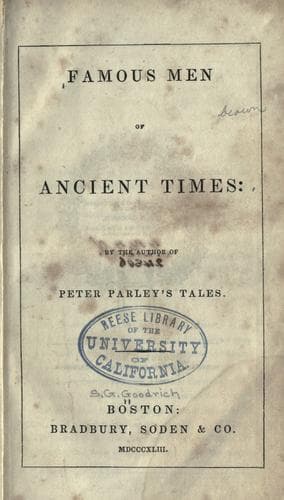
Famous Men of Ancient TimesGoodrich, Samuel G. (Samuel Griswold)
History
Famous Men of Ancient Times
Goodrich, Samuel G. (Samuel Griswold)
Biography -- Juvenile literature; Men -- Biography -- Juvenile literature
The favorite wife of the prophet, Ayesha, hung over her husband in
his last moments, sustaining his drooping head upon her knee, as he
lay stretched upon the carpet; watching with trembling anxiety his
changing countenance, and listening to the last broken sounds of his
voice. His disease, as it drew towards its termination, was attended at
intervals with most excruciating pains, which he constantly ascribed
to the fatal morsel taken at Chaibar; and as the mother of Bashar,
his companion who had died upon the spot from the same cause, stood
by his side, he exclaimed, “O mother of Bashar, the cords of my heart
are now breaking of the food which I ate with your son at Chaibar.” In
his conversation with those around him, he mentioned it as a special
prerogative granted to him, that the angel of death was not allowed
to take his soul till he had respectfully asked permission of him, and
this permission he condescendingly granted. Recovering from a swoon
into which the violence of his pains had thrown him, he raised his eyes
towards the roof of the house, and with faltering accents exclaimed, “O
God! pardon my sins. Yes, I come among my fellow-laborers on high!” His
face was then sprinkled with water, by his own feeble hand, and shortly
after he expired.
The city, and more especially the house of the prophet, became at once
a scene of sorrowful but confused lamentation. Some of his followers
could not believe that he was dead. “How can he be dead, our witness,
our intercessor, our mediator with God? He is not dead. Like Moses and
Jesus, he is wrapped in a holy trance, and speedily will he return to
his faithful people.” The evidence of sense was disregarded, and Omar,
brandishing his scimitar, threatened to strike off the heads of the
infidels who should affirm that the prophet was no more. The tumult was
at length appeased, by the moderation of Abubeker. “Is it Mohammed,”
said he, “or the God of Mohammed, whom ye worship? The God of Mohammed
liveth forever, but the apostle was a mortal like ourselves, and,
according to his own prediction, he hath experienced the common fate of
mortality.”
Public-domain text, read in full here on John Shaqi.
Reviews
Reviews
No reviews yet
Be the first to share your thoughts on this work.
Join the Discussion
Join the discussion
Sign in to leave a comment or review.
Sign InorCreate an account