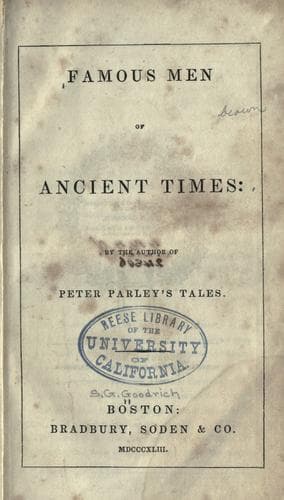
Famous Men of Ancient TimesGoodrich, Samuel G. (Samuel Griswold)
History
Famous Men of Ancient Times
Goodrich, Samuel G. (Samuel Griswold)
Biography -- Juvenile literature; Men -- Biography -- Juvenile literature
The prophet’s remains were deposited at Medina, in the very room where
he breathed his last, the floor being removed to make way for his
sepulchre, and a simple and unadorned monument was, some time after,
erected over them. The house itself has long since mouldered, or been
demolished, but the place of the prophet’s interment is still made
conspicuous to the superstitious reverence of his disciples. The story
of his relics being suspended in the air, by the power of loadstone in
an iron coffin, and that too at Mecca, instead of Medina, is a mere
idle fabrication. His tomb at the latter place has been visited by
millions of pilgrims, and, from the authentic accounts of travellers
who have visited both these holy cities in disguise, we learn that it
is constructed of plain mason work, fixed without elevation upon the
surface of the ground. The urn which encloses his body is protected by
a trellis of iron, which no one is permitted to pass.
The Koran or Alkoran, meaning _the Book_, is a collection of all the
various fragments which the prophet uttered during the period in which
he professed to exercise the apostolic office. They were originally
written on scattered leaves, but they were collected by Abubeker, two
years after Mohammed’s death. They are in the purest and most refined
dialect of Arabia, and are distinguished by extraordinary graces of
style.
The Koran furnishes not only the divinity, but the civil law of the
Mohammedans. It professes to contain the revelation of God’s will by
Gabriel to Mohammed, and through him to mankind. One of the books gives
an account of the translation of the prophet by night to the third
heaven, upon a winged animal, named Alborak, and resembling an ass,
where he saw unutterable things. The great doctrines of the Koran, as
before stated, are the existence of one supreme God, to whom alone
adoration and obedience are due. It declares that the divine law was
faithfully delivered by Adam, Noah, Abraham, Moses, and Christ. It
declares the immortality of the soul of man, and the final judgment,
and sets forth that the good are to dwell in everlasting bliss, amid
shady and delicious groves, and attended by heavenly virgins. The hope
of salvation is not confined to the Moslem, but is extended to all who
believe in God and do good works. Sinners, particularly unbelievers,
are to be driven about in a dark burning hell, forever.
The practical duties enjoined by the Koran, are the propagation
of Islamism, and prayers directed to the temple of Mecca, at five
different periods of the day, together with fasting, alms, religious
ablutions, pilgrimages to Mecca, &c. It allows a man but four wives,
though the prophet had seventeen, and it is curious to add that all
were widows, save one. It strongly prohibits usury, gaming, wine and
pork.
Public-domain text, read in full here on John Shaqi.
Reviews
Reviews
No reviews yet
Be the first to share your thoughts on this work.
Join the Discussion
Join the discussion
Sign in to leave a comment or review.
Sign InorCreate an account