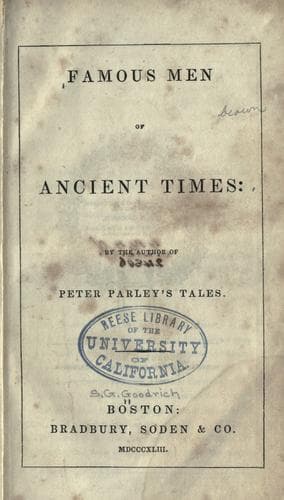
Famous Men of Ancient TimesGoodrich, Samuel G. (Samuel Griswold)
History
Famous Men of Ancient Times
Goodrich, Samuel G. (Samuel Griswold)
Biography -- Juvenile literature; Men -- Biography -- Juvenile literature
We cannot deny to Mohammed the possession of extraordinary genius. He
was a man of great eloquence, and the master of a beautiful style of
composition; and he possessed that majesty of person, which, united to
his mental qualities, gave him great ascendancy over those who came
into his presence. He lived in a dark age, amid a benighted people;
yet, without the aids of education, he mastered the religious systems
of the day, and took a broad and sagacious view of the moral and
political condition of the people of Asia. He conceived the sublime
idea of uniting, by one mighty truth, the broken fragments of his own
nation, and the destruction of idolatry by the substitution of the
worship of one God. It is true, that he sought to accomplish these
ends by unlawful means—by imposture, and the bloody use of the sword;
we must admit, also, that he was licentious and although we cannot
fail to condemn his character, we must acknowledge the splendor of
his abilities and allow that while he imposed on his followers, he
established a faith infinitely above Paganism, and sprinkled with many
rays of light from the fountain of Divine Truth.
[Illustration]
[Illustration]
BELISARIUS.
This celebrated general, to whom the emperor Justinian is chiefly
indebted for the glory of his reign, was a native of Germania, on the
confines of Thrace, and was born about the year 505. It is probable
that he was of noble descent, liberally educated, and a professor of
the Christian faith. The first step in his military career was an
appointment in the personal guard of Justinian, while that prince was
yet heir apparent to the throne.
The Roman or Byzantine empire, at this period, embraced almost exactly
the present territory of the Turkish dominions in Europe and Asia
Minor, with the addition of Greece—Constantinople being its capital.
Italy was held by the Goths; Corsica, Sardinia and Barbary in Africa,
by the Vandals.
Justin I., an Illyrian peasant, having distinguished himself as a
soldier, had become emperor. His education was of course neglected, and
such was his ignorance, that his signature could only be obtained by
means of a wooden case, which directed his pen through the four first
letters of his name. From his accession, the chief administration of
affairs devolved on Justinian, his nephew and intended heir, whom he
was reluctantly compelled to raise from office to office, and at length
to acknowledge as his partner on the throne. His death, after a languid
reign of nine years and a life of nearly fourscore, left Justinian sole
sovereign in name, as well as in fact.
Public-domain text, read in full here on John Shaqi.
Reviews
Reviews
No reviews yet
Be the first to share your thoughts on this work.
Join the Discussion
Join the discussion
Sign in to leave a comment or review.
Sign InorCreate an account