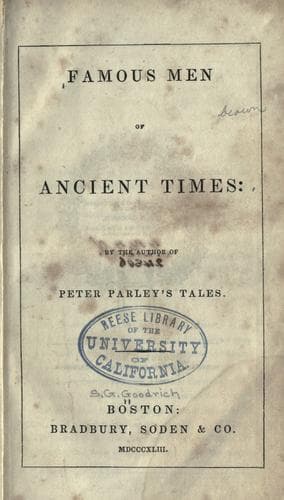
Famous Men of Ancient TimesGoodrich, Samuel G. (Samuel Griswold)
History
Famous Men of Ancient Times
Goodrich, Samuel G. (Samuel Griswold)
Biography -- Juvenile literature; Men -- Biography -- Juvenile literature
In order to appreciate the life and actions of Belisarius, it is
necessary to understand the character of the new emperor, during
whose long reign his great exploits were performed. The first act of
Justinian on ascending the throne, was to marry a dissolute actress,
named Theodora, who, though licentious, avaricious, cruel and
vindictive, soon acquired an almost complete control over him. His mind
was essentially feeble and inconstant, and, though his Christian faith
was doubtless sincere, it was less fruitful of virtues than of rites
and forms. At his accession his treasury was full; but it was soon
exhausted by his profuseness, and heavy taxes were imposed, offices
put to sale, charities suppressed, private fortunes seized, and, in
short, every act of rapacity, injustice and oppression, practised by
his ministers, to support the wasteful magnificence of the court.
The troops of the empire at this period were by no means what they
had been in the time of Scipio and Cæsar. They consisted, to a great
extent, of foreign mercenaries, and were divided into squadrons
according to their country; thus destroying all unity of feeling, and
annihilating that national spirit which once made the Roman arms the
terror of the world. These hired troops, which greatly outnumbered
the native soldiers, marched under their own national banner, were
commanded by their own officers, and usually followed their own
military regulations. The inefficiency of such mingled and discordant
forces, is obvious; yet it was under such a system that Belisarius
entered upon his military career.
With a feeble and corrupt government, an ill-appointed and trustless
army, the Roman empire was still surrounded with powerful enemies. It
is scarcely possible to conceive of a great nation in a condition of
more complete debility and helplessness, than was the kingdom of the
Cæsars, at the period in which Belisarius appears upon the active stage
of life.
Kobad, king of Persia, after a long cessation of hostilities, renewed
the war toward the close of Justin’s reign, by the invasion of
Iberia, which claimed the protection of the emperor. At this period,
Belisarius, being about twenty years of age, had the command of a
squadron of horse, and was engaged in some of the conflicts with the
Persian forces, on the borders of Armenia. In conjunction with an
officer named Sittas, he ravaged a large extent of territory, and
brought back a considerable number of prisoners.
On a second incursion, however, they were less fortunate; for, being
suddenly attacked by the Persian forces, they were entirely defeated.
It appears that Belisarius incurred no blame, for he was soon after
promoted to the post of governor of Dara, and the command of the forces
stationed there. It was at this place that he chose Procopius, the
historian, as his secretary, and who afterwards repaid his kindness by
a vain attempt to brand his name with enduring infamy.
Public-domain text, read in full here on John Shaqi.
Reviews
Reviews
No reviews yet
Be the first to share your thoughts on this work.
Join the Discussion
Join the discussion
Sign in to leave a comment or review.
Sign InorCreate an account