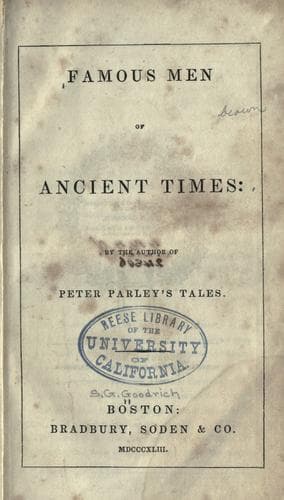
Famous Men of Ancient TimesGoodrich, Samuel G. (Samuel Griswold)
History
Famous Men of Ancient Times
Goodrich, Samuel G. (Samuel Griswold)
Biography -- Juvenile literature; Men -- Biography -- Juvenile literature
Soon after Belisarius obtained the command of Dara, Justinian came
to the throne, and enjoined it upon his generals to strengthen the
defences of the empire in that quarter. This was attempted, but the
Persians baffled the effort. Belisarius was now appointed general of
the East, being commander-in-chief of the whole line of the Asiatic
frontier. Foreseeing that a formidable struggle was soon to ensue, he
applied himself to the raising and disciplining an army. He traversed
the neighboring provinces in person, and at last succeeded in mustering
five and twenty thousand men. These, however, were without discipline,
and their spirit was depressed by the ill success that had long
attended the Roman arms.
In this state of things, the news suddenly came, that 40,000 men, the
flower of the Persian army, commanded by Firouz, was marching upon
Dara. Confident of victory, the Persian general announced his approach,
by the haughty message that a bath should be ready for him at Dara
the next evening. Belisarius made no other reply than preparations for
battle. Fortifying himself in the best manner he was able, he awaited
the onset; exhorting his men, however, by every stimulating motive he
could suggest, to do honor to the name and fame of Rome.
The battle began by a mutual discharge of arrows, so numerous as to
darken the air. When the quivers were exhausted, they came to closer
combat. The struggle was obstinate and bloody; and the Persians were
already about to win the victory, when a body of horse, judiciously
stationed behind a hill by Belisarius, rushed forward, and turned the
tide of success. The Persians fled, and the triumph of Belisarius was
complete. They left their royal standard upon the field of battle, with
8000 slain. This victory had a powerful effect, and decided the fate of
the campaign.
The aged Kobad, who had conceived a profound contempt for the Romans,
was greatly irritated by the defeat of his troops. He determined upon
a still more powerful effort, and the next season sent a formidable
army to invade Syria. Belisarius, with a promptitude that astounded he
enemy, proceeded to the defence of this province, and, with an inferior
force, compelled the Persian army to retreat. Obliged at length, by
his soldiers, against his own judgment, to give battle to the enemy,
he suffered severely, and only avoided total defeat by the greatest
coolness and address. Even the partial victory of the enemy was without
advantage to them, for they were obliged to retreat, and abandon their
enterprise. Soon after this event, Kobad died, in his eighty-third
year, and his successor, Nushirvan, concluded a treaty of peace with
Justinian.
Public-domain text, read in full here on John Shaqi.
Reviews
Reviews
No reviews yet
Be the first to share your thoughts on this work.
Join the Discussion
Join the discussion
Sign in to leave a comment or review.
Sign InorCreate an account