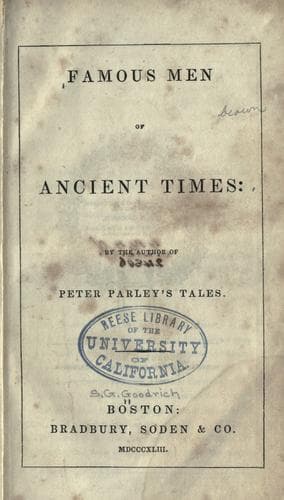
Famous Men of Ancient TimesGoodrich, Samuel G. (Samuel Griswold)
History
Famous Men of Ancient Times
Goodrich, Samuel G. (Samuel Griswold)
Biography -- Juvenile literature; Men -- Biography -- Juvenile literature
[Footnote 1: These were a digest of the civil law of Rome, made by the
order of Justinian, and have been preserved to our time. They contained
five hundred and thirty-four decisions or judgments of lawyers, to
which the emperor gave the force of law. The compilation consists of
fifty books, and has contributed to save Justinian’s name from the
contempt and reproach which had otherwise been heaped upon it.]
[Footnote 2: A space where the chariot races were exhibited.]
[Footnote 3: This portion of the story of Belisarius has been the
subject of controversy. It has been doubted by Gibbon and other
historians, whether the infliction of blindness upon Belisarius and
his beggary, were not mere traditionary fables. But Lord Mahon, in his
excellent life of the great Roman general from which we have drawn the
preceding account, appears to have established their authenticity. The
beautiful tale of Belisarius by Marmontel, is fictitious in many of its
details.]
[Illustration]
ATTILA, KING OF THE HUNS
This renowned barbarian was the son of Mandras, and of a royal line. He
served in the army of his uncle, Roas, who was king of the Huns. At his
death, in 433, he succeeded him, sharing the throne with his brother
Bleda. The Huns at this period were very numerous and warlike. They
extended over the southern part of Russia, and a considerable portion
of the present empire of Austria. Attila’s kingdom lay between the
Carpathian mountains and the Danube, and was called Pannonia.
At this period, the Roman empire had been for more than a century
divided into the Eastern and Western empire. Theodosius II. was
now emperor of the former, and Constantinople its capital, while
Valentinian III. was emperor of the latter, and Rome, or Ravenna, the
seat of his government.
Both branches of the Roman empire were now sunk in the lap of luxury.
They were spread over with splendid cities, and enriched with all the
refinements of art, and all the spoils gathered from every quarter
of the world. These offered a tempting inducement to the fierce and
hungry barbarians of the north. Alaric[4] had shown the way to Rome a
few years before, and taught the weakness of the queen of the world.
Constantinople was not likely to be an inferior or more inaccessible
prize. Attila’s dominions bordered upon those of the two empires, and
the distance to either capital was not more than five or six hundred
miles.
Among the first achievements of the two brothers, they threatened
the Eastern empire with their armies, and twice compelled the weak
Theodosius to purchase peace on humiliating terms. They then extended
their dominions both east and west, until they reigned over the whole
country from the Baltic to the Caspian Sea.
Public-domain text, read in full here on John Shaqi.
Reviews
Reviews
No reviews yet
Be the first to share your thoughts on this work.
Join the Discussion
Join the discussion
Sign in to leave a comment or review.
Sign InorCreate an account