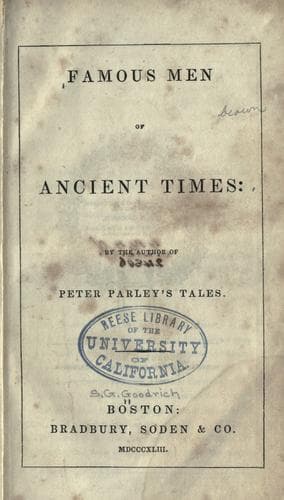
Famous Men of Ancient TimesGoodrich, Samuel G. (Samuel Griswold)
History
Famous Men of Ancient Times
Goodrich, Samuel G. (Samuel Griswold)
Biography -- Juvenile literature; Men -- Biography -- Juvenile literature
Attila was regarded by the Huns as their bravest warrior, and most
skilful general. He performed such feats of valor, and success so
uniformly attended his career, that the ignorant and superstitious
people were inclined to think him more than mortal. He took advantage
of this feeling, and pretended that he had found the sword of their
tutelar god, and that with this he intended to conquer the whole earth.
Being unwilling to hold a divided sceptre, he caused his brother Bleda
to be murdered, and when he gave out that it was done by the command of
God, the event was celebrated with the greatest demonstrations of joy.
Being now sole master of a warlike people, his ambition made him the
terror of all the surrounding nations. It was a saying of his own, that
no grass grew where his horse had set his foot, and the title of the
“Scourge of God” was assigned to him, as characterizing his career.
He extended his dominions over the whole of Germany and Scythia. The
Vandals, the Ostrogoths, and a part of the Franks, acknowledged his
sway, and both the Eastern and Western empires paid him tribute.
Historians tell us that his army amounted to 700,000 men.
Having heard of the riches of Persia, he directed his march against it.
Being defeated on the plains of Armenia, he turned back, to satisfy
his desire of plunder in the dominions of the emperor of the East.
Regardless of existing treaties, he laid waste the whole country from
the Black Sea to the Adriatic. In three bloody engagements, he defeated
the troops sent against him by Theodosius. Thrace, Macedonia, and
Greece, were overrun by the savage robber, and seventy flourishing
cities were utterly destroyed.
Theodosius was now at the mercy of the victor and was obliged to sue
for peace. One of the servants of Attila, named Edekon, was tempted
by an agent of the emperor to undertake the assassination of his
master, on his return to Pannonia; but, at the moment he was about to
accomplish his object, his courage failed him, he fell on his knees
before Attila, confessed his criminal design, and disclosed the plot.
Constantinople trembled at the idea of Attila’s revenge; but he was
contented with upbraiding Theodosius, and the execution of Crisapheus,
who had drawn his servant into the scheme.
Priscus, a Roman historian, who was an ambassador to Attila in the
year 448, gives an interesting account of the king and his people. He
found the palace in the midst of a large village. The royal edifice was
entirely of wood: the houses of the Huns were also of wood, sometimes
mixed with mortar made of earth. The only stone building was a set
of baths. The wooden pillars of the palace were carved and polished,
and the ambassador could discover some evidence of taste in the
workmanship, as well as barbarous magnificence in the display of rich
spoils taken from more civilized nations.
Public-domain text, read in full here on John Shaqi.
Reviews
Reviews
No reviews yet
Be the first to share your thoughts on this work.
Join the Discussion
Join the discussion
Sign in to leave a comment or review.
Sign InorCreate an account