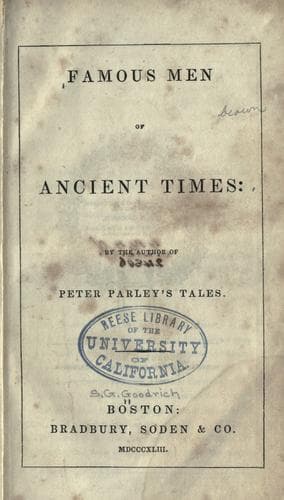
Famous Men of Ancient TimesGoodrich, Samuel G. (Samuel Griswold)
History
Famous Men of Ancient Times
Goodrich, Samuel G. (Samuel Griswold)
Biography -- Juvenile literature; Men -- Biography -- Juvenile literature
Though his death seemed to be the source of universal gladness, yet
many of his favorites lamented his fall, and were grieved to see
that their pleasures and amusements were terminated by the death of
the patron of debauchery and extravagance. Even the king of Parthia
sent ambassadors to Rome to condole with the Romans, and to beg that
they would honor and revere the memory of Nero. His statues were
also crowned with garlands of flowers, and many believed that he was
not dead, but that he would soon make his appearance and take a due
vengeance upon his enemies. It will be sufficient to observe, in
finishing the character of this tyrannical emperor and detestable man,
that the name of _Nero_ is, even now, the common designation of a
barbarous and unfeeling oppressor.
[Illustration]
LUCIUS ANNÆUS SENECA.
This individual, whose “Morals” are so familiar to us, was born
at Corduba, in Spain, six years before Christ. His father was a
rhetorician of some celebrity, and a portion of his works has come down
to our time. While Lucius was yet a child, he removed from Corduba to
Rome, which henceforward became his residence. The son, possessing
very promising talents, received the greatest care and attention in
respect to his education. He was taught eloquence by his father, and
took lessons in philosophy from the most celebrated masters. According
to the custom of those who sought to excel in wisdom and knowledge, he
travelled in Greece and Egypt, after completing his studies, and his
work entitled _Quæstiones Naturales_ showed that he made good use of
his opportunities during this excursion; it also proves that he was
master of the science of his time.
Young Seneca was fascinated with the philosophical speculations of
the Stoics,[5] to which sect he became devoted. He even adopted the
austere modes of life they inculcated, and refused to eat the flesh of
animals; but when the emperor, Tiberius,[6] threatened to punish some
Jews and Egyptians for abstaining from certain meats, at the suggestion
of his father, he departed from this singularity. In compliance with
his father’s advice, who urged upon him the necessity of devoting
himself to some kind of business, he adopted the profession of an
advocate.
Public-domain text, read in full here on John Shaqi.
Reviews
Reviews
No reviews yet
Be the first to share your thoughts on this work.
Join the Discussion
Join the discussion
Sign in to leave a comment or review.
Sign InorCreate an account