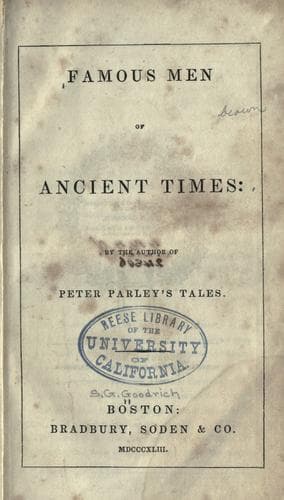
Famous Men of Ancient TimesGoodrich, Samuel G. (Samuel Griswold)
History
Famous Men of Ancient Times
Goodrich, Samuel G. (Samuel Griswold)
Biography -- Juvenile literature; Men -- Biography -- Juvenile literature
As a pleader, Seneca appeared to great advantage, and consequently
excited the envy of Caligula, who aspired to the reputation of an
orator. Apprehensive of the consequences, he changed his views, and
became a candidate for the honors and offices of the state. He was made
prætor, under Claudius, but, being charged with a shameful intrigue
with a lady of rank, he was banished to Corsica. Though his guilt was
not satisfactorily proved, he continued for five years in exile; during
which period he wrote a treatise on Consolation. In this, he seems to
draw contentment and peace from philosophical views, and one would
fancy that he was elevated by these, above the evils of his condition.
Yet, unhappily for his reputation in respect to consistency and
sincerity, history tells us that, at this period, he was suing to the
emperor in the most abject terms for restitution.
Claudius[7] at length married Agrippina, and Seneca, being recalled,
was made preceptor of Nero, the son of Agrippina, who was destined to
become emperor. From the favorable traits of character displayed by
the pupil of the philosopher in the early part of his career, it might
seem that Seneca’s instructions had exerted a good influence over him.
But an impartial scrutiny of the events of that period has led to the
probable conclusion that he was a pander to the worst of Nero’s vices.
It is certain that he acquired immense wealth in a short period of
time, and it appears that this was obtained through the munificence
of his royal patron. The latter was avaricious and mercenary, and was
likely to part with his money only for such things as ministered to his
voluptuous passions.
The possessions of Seneca were enormous. He had several gardens and
villas in the country, and a magnificent palace in Rome. This was
sumptuously furnished, and contained five hundred tables of cedar,
with feet of ivory, and all of exquisite workmanship. His ready cash
amounted to about twelve millions of dollars. It appears certain
that such riches could not have been acquired by means of Seneca’s
precepts; and the inference of many of his contemporaries, as well as
of posterity, has been, that the virtue which appears so lovely in his
pages was but the decorous veil of avarice, vice, and crime.
Public-domain text, read in full here on John Shaqi.
Reviews
Reviews
No reviews yet
Be the first to share your thoughts on this work.
Join the Discussion
Join the discussion
Sign in to leave a comment or review.
Sign InorCreate an account