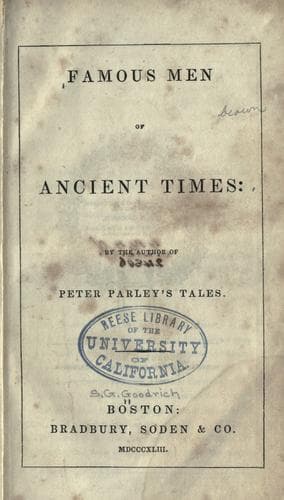
Famous Men of Ancient TimesGoodrich, Samuel G. (Samuel Griswold)
History
Famous Men of Ancient Times
Goodrich, Samuel G. (Samuel Griswold)
Biography -- Juvenile literature; Men -- Biography -- Juvenile literature
For a period after his accession to the throne, Nero’s conduct was
deserving of praise; but he soon threw off all regard even to decency,
and launched forth upon that career which has made his name a by-word
and reproach for all after time. Seneca, being accused of having
amassed immense wealth by improper means, became greatly alarmed;
for he knew the tyrant so well as to foresee that, under color of
this charge, he was very likely to sacrifice him, in order to obtain
his property. Pretending, therefore, to be indifferent to riches, he
begged the emperor to accept of his entire fortune, and permit him to
spend the remainder of his days in the quiet pursuits of philosophy.
The emperor, with deep dissimulation, refused this offer—no doubt
intending in some other way to compass the ruin of Seneca.
Aware of his danger, the philosopher now kept himself at home for
a long period, as if laboring under disease. Some time after, a
conspiracy for the murder of Nero, headed by Piso, was detected.
Several of the most noble of the Roman senators were concerned, and
Seneca’s name was mentioned as an accessory. Nero, doubtless glad of an
opportunity to sacrifice him, now sent a command that he should destroy
himself.
It has been a question whether Seneca was really concerned in the
conspiracy of Piso. The proof brought against him was not indeed
conclusive, but it is obvious that his position might lead him to
desire the death of the tyrant, as the only means of safety to himself;
and Seneca’s character, unfortunately, is not such as to shield his
memory against strong suspicion of participation in the alleged crime.
Seneca was at table, with his wife, Paulina, and two of his friends,
when the messenger of Nero arrived. He heard the words which commanded
him to take his own life, with philosophic firmness, and even with
apparent joy. He observed that such a mandate might long have been
expected from a man who had murdered his own mother and assassinated
his best friends. He wished to dispose of his possessions as he
pleased, but his request was refused. When he heard this, he turned to
those around who were weeping at his fate, and told them, that, since
he could not leave them what he believed his own, he would leave them
at least his own life for an example—an innocent conduct, which they
might imitate, and by which they might acquire immortal fame.
Against their tears and wailings, he exclaimed with firmness, and asked
them whether they had not learned better to withstand the attacks of
fortune and the violence of tyranny. As for his wife, he attempted to
calm her emotions, and when she seemed resolved to die with him, he
said he was glad to have his example followed with so much constancy.
Their veins were opened at the same moment; but Nero, who was partial
to Paulina, ordered the blood to be stopped, and her life was thus
preserved.
Public-domain text, read in full here on John Shaqi.
Reviews
Reviews
No reviews yet
Be the first to share your thoughts on this work.
Join the Discussion
Join the discussion
Sign in to leave a comment or review.
Sign InorCreate an account