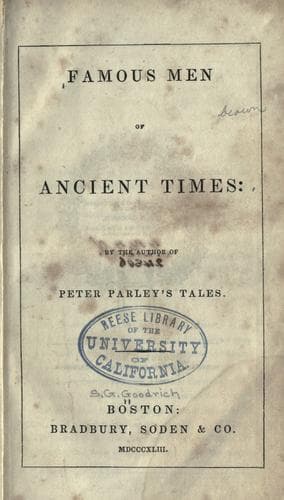
Famous Men of Ancient TimesGoodrich, Samuel G. (Samuel Griswold)
History
Famous Men of Ancient Times
Goodrich, Samuel G. (Samuel Griswold)
Biography -- Juvenile literature; Men -- Biography -- Juvenile literature
Seneca’s veins bled but slowly, and the conversation of his dying
moments was collected by his friends, and preserved among his works. To
hasten his death, he drank a dose of poison, but it had no effect, and
therefore he ordered himself to be carried to a hot bath, to accelerate
the operation of the draught, and to make the blood flow more freely.
This was attended with no better success, and, as the soldiers were
clamorous, he was carried into a stove, and suffocated by the steam.
Thus he died, in the 66th year of the Christian era.
The death of Seneca has been loudly applauded, and has sometimes been
pronounced sublime; but this is owing to an ignorance of the time,
and inattention to Seneca’s own doctrines. With the Stoics, death was
nothing; “It is not an evil, but the absence of all evil.” This was
their creed. With such principles, there could be no fear of death,
and consequently, we find that courage to die—if it be courage to
encounter that which is not an evil—was common in Seneca’s time. “At
that period of languor and luxury,” says M. Nisard, “of monstrous
effeminacies, of appetites for which the world could hardly suffice—of
perfumed baths, of easy and disorderly intrigues, there were daily men
of all ranks, of all fortunes, of all ages, who released themselves
from their evils by death. How was it possible for them to avoid
suicide, with no other consolation than the philosophy of Seneca, and
his theories on the delights of poverty?
“Marcellinus[8] is attacked with a painful but curable malady. He is
young, rich, has slaves, friends, everything to make life pleasant: no
matter, he conceives the fancy of the pleasure of dying. He assembles
his friends; he consults them as if he were going to marry. He
discusses with them his project of suicide, and puts it to the vote.
Some advise him to do as he pleases; but a Stoic, a friend of Seneca’s,
then present, exhorts him bravely to die. His principal reason is that
he is _ennuyé_. No one contradicts the Stoic. Marcellinus thanks his
friends, and distributes money to his slaves. He abstains for three
days from all food, and is then carried into a warm bath, where he
quickly expires, having muttered some words on the pleasure he felt in
dying.
“This pleasure was so little of an affectation, so much had it become
the fashion, that some of the austere Stoics thought themselves bound
to place certain restrictions upon it. They committed suicide from
_ennui_, from idleness, from want of patience to cure themselves of
their ills,—for distraction—much in the same way that they killed
each other in duels, under Cardinal Richelieu.”
Public-domain text, read in full here on John Shaqi.
Reviews
Reviews
No reviews yet
Be the first to share your thoughts on this work.
Join the Discussion
Join the discussion
Sign in to leave a comment or review.
Sign InorCreate an account