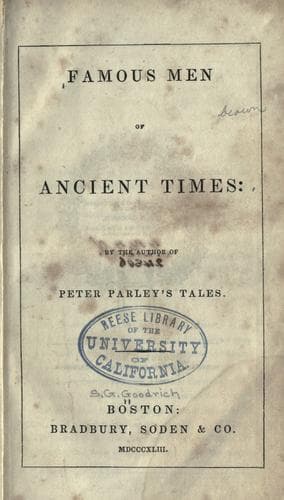
Famous Men of Ancient TimesGoodrich, Samuel G. (Samuel Griswold)
History
Famous Men of Ancient Times
Goodrich, Samuel G. (Samuel Griswold)
Biography -- Juvenile literature; Men -- Biography -- Juvenile literature
The Sibylline Oracles, having received information from the Jews that
a child was to be born, who should be the Saviour of the world, and
to whom nations and empires should bow with submission, pretended to
foretell that this event would occur in the year of Rome, 714, after
the peace concluded between Augustus and Antony. Virgil, viewing this
prophecy with the vivid imagination of a poet, and willing to flatter
the ambition of his patron, composed his celebrated eclogue, entitled
Pollio, in which he supposes the child, who was thus to unite mankind
and restore the golden age, to be the offspring of Octavia, wife of
Antony, and half sister to Augustus. In this production, the consul
Pollio, Octavia, and even the unborn infant, are flattered with his
usual delicacy; and the rival triumviri, though a short time before in
open hostility, have the honor of equally sharing the poet’s applause.
While Pollio, who seems to have been the most accomplished man of his
age, and is celebrated as a poet, soldier, orator and historian, was
engaged in an expedition against the Parthini, whom he subdued, Virgil
addressed to him his Pharmaceutria, one of the most beautiful of all
his eclogues, and in imitation of a poem of the same name, by his
favorite author, Theocritus. This production is the more valuable, as
it has handed down to posterity some of the superstitious rites of the
Romans and the heathen notions of enchantment. Virgil himself seems to
have been conscious of the beauty of his subject, and the dignity of
the person whom he was addressing; and, accordingly, has given us, by
the fertility of his genius and the brilliancy of his imagination, some
of the most sublime images that are to be found in any of the writings
of antiquity.
By the advice, and indeed at the earnest entreaty of Augustus, Virgil,
in his thirty-fourth year, retired to Naples, and formed the plan of
his Georgics: a design as new in Latin verse, as pastorals, before
his, were in Italy. These he undertook for the interest, and to
promote the welfare, of his country. As the continual civil wars had
entirely depopulated and laid waste the land usually appropriated for
cultivation, the peasants had turned soldiers, and their farms became
scenes of desolation. Famine and insurrection were the inevitable
consequences that followed such overwhelming calamities. Augustus,
therefore, resolved to revive the decayed spirit of husbandry, and
began by employing Virgil to recommend it with all the insinuating
charms of poetry. This work took up seven of the most vigorous years of
his life, and fully answered the expectations of his patron.
Public-domain text, read in full here on John Shaqi.
Reviews
Reviews
No reviews yet
Be the first to share your thoughts on this work.
Join the Discussion
Join the discussion
Sign in to leave a comment or review.
Sign InorCreate an account