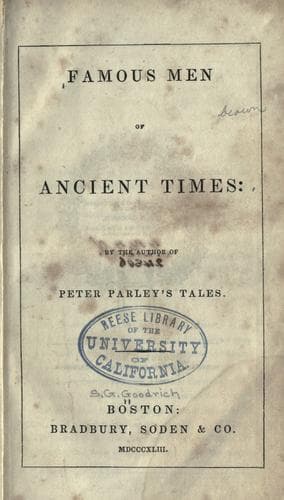
Famous Men of Ancient TimesGoodrich, Samuel G. (Samuel Griswold)
History
Famous Men of Ancient Times
Goodrich, Samuel G. (Samuel Griswold)
Biography -- Juvenile literature; Men -- Biography -- Juvenile literature
Augustus, having conquered his rival, Antony, gave the last wound to
expiring liberty, by usurping the exclusive government of the Roman
empire. To reconcile a nation, naturally jealous of its freedom, to
this, seems to have been the grand object of Virgil, in his Æneid. This
poem was begun in the forty-fifth year of the author’s life, and not
only displays admirable poetical genius, but great political address.
Not an incident that could in any way tend to flatter the Roman
people into a submission to the existing government, has escaped his
penetrating judgment. He traces their origin to the Trojans, and makes
Augustus a lineal descendant of Æneas. At the command of the gods they
obey him, and in return are promised the empire of the world.
So anxious was Augustus as to the result of this poem, that he insisted
upon having part of it read before the whole was completed. Gratitude,
after threats and entreaties had been used in vain, at length induced
its author to comply; and, knowing that Octavia, who had just lost her
son, Marcellus, would be present, Virgil fixed upon the sixth book,
perhaps the finest part of the whole Æneid. His illustrious auditors
listened with all the attention which such interesting narrative and
eloquent recital demanded, till he came to that beautiful lamentation
for the death of young Marcellus, and where, after exhausting
panegyric, he has artfully suppressed the name of its object, till the
concluding verse:
“Tu Marcellus eris.”
At these words, Octavia, overcome with surprise and sorrow, fainted
away; but, on recovering, was so highly gratified at having her son
thus immortalized, that she presented the poet with ten _sesterces_ for
each line; amounting, in the whole, to about ten thousand dollars.
Having at length brought his Æneid to a conclusion, Virgil proposed
travelling into Greece, and devoting three years to the correction and
improvement of his favorite work. Having arrived at Athens, he met with
Augustus, who was returning from a victorious expedition to the East,
and who requested the company of the poet back to Italy. The latter
deemed it his duty to comply; but, being desirous to see as many of
the Grecian antiquities as the time would allow, went for that purpose
to Megara. Here he was seized with a dangerous illness, which, from
neglect, and the agitation of the vessel in returning to Italy, proved
mortal, at Brundusium. Thus the great poet died on the twenty-second
of September, nineteen years B. C, and at a period when he had
nearly completed his fifty-second year. He expired with the greatest
tranquillity; and his remains, being carried to Naples, were interred
in a monument, erected at a small distance from the city; where it is
still shown, with the following inscription, said to have been dictated
by him on his death-bed:
Mantua me genuit; Calabri rapuere, tenet nunc
Parthenope; cecini pascua, rura, duces.
Public-domain text, read in full here on John Shaqi.
Reviews
Reviews
No reviews yet
Be the first to share your thoughts on this work.
Join the Discussion
Join the discussion
Sign in to leave a comment or review.
Sign InorCreate an account