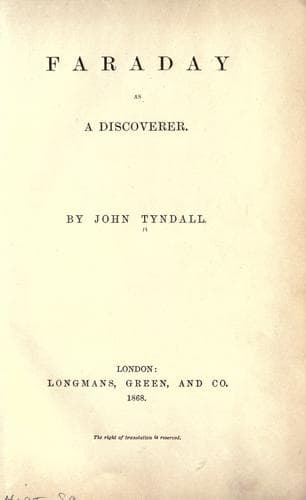
Faraday, Michael, 1791-1867; Physicists -- Great Britain -- Biography
And now he gradually abolishes those so-called poles, to the attraction
of which electric decomposition had been ascribed. He connected a piece
of turmeric paper moistened with the sulphate of soda with the positive
conductor of his machine; then he placed a metallic point in connection
with his discharging train opposite the moist paper, so that the
electricity should discharge through the air towards the point. The
turning of the machine caused the corners of the piece of turmeric paper
opposite to the point to turn brown, thus declaring the presence of
alkali. He changed the turmeric for litmus paper, and placed it, not
in connection with his conductor, but with his discharging train, a
metallic point connected with the conductor being fixed at a couple of
inches from the paper; on turning the machine, acid was liberated at
the edges and corners of the litmus. He then placed a series of pointed
pieces of paper, each separate piece being composed of two halves,
one of litmus and the other of turmeric paper, and all moistened with
sulphate of soda, in the line of the current from the machine. The
pieces of paper were separated from each other by spaces of air. The
machine was turned; and it was always found that at the point where the
electricity entered the paper, litmus was reddened, and at the point
where it quitted the paper, turmeric was browned. 'Here,' he urges,
'the poles are entirely abandoned, but we have still electrochemical
decomposition.' It is evident to him that instead of being attracted by
the poles, the bodies separated are ejected by the current. The effects
thus obtained with poles of air he also succeeded in obtaining with
poles of water. The advance in Faraday's own ideas made at this time is
indicated by the word 'ejected.' He afterwards reiterates this view:
the evolved substances are expelled from the decomposing body, and 'not
drawn out by an attraction.
Having abolished this idea of polar attraction, he proceeds to enunciate
and develop a theory of his own. He refers to Davy's celebrated Bakerian
Lecture, given in 1806, which he says 'is almost entirely occupied in
the consideration of electrochemical decompositions.' The facts recorded
in that lecture Faraday regards as of the utmost value. But 'the mode
of action by which the effects take place is stated very generally;
so generally, indeed, that probably a dozen precise schemes of
electrochemical action might be drawn up, differing essentially from
each other, yet all agreeing with the statement there given.'
Public-domain text, read in full here on John Shaqi.
Reviews
Reviews
No reviews yet
Be the first to share your thoughts on this work.
Join the Discussion
Join the discussion
Sign in to leave a comment or review.
Sign InorCreate an account