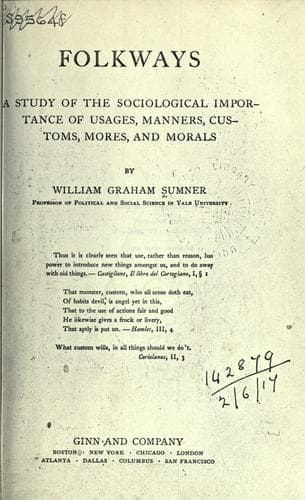
Folkways: A Study of the Sociological Importance of Usages, Manners, Customs, Mores, and MoralsSumner, William Graham
General
Folkways: A Study of the Sociological Importance of Usages, Manners, Customs, Mores, and Morals
Sumner, William Graham
Manners and customs
the seventy-third Psalm, the author is perplexed by the
prosperity of the wicked, and the contrast of his own fortunes.
"Surely in vain have I cleansed my heart and washed my hands in
innocency, for all day long have I been plagued, and chastened
every morning." He says that at last the wicked were cast down.
He was brutish and ignorant not to see the solution. It is that
the wicked prosper for a time only. He will cleave unto God. The
book of Job is a discussion of the relation between goodness and
happiness. The crusaders were greatly perplexed by the victories
of the Mohammedans. It seemed to be proved untrue that God would
defend His own Name or the true and holy cause. Louis XIV, when
his armies were defeated, said that God must have forgotten all
which he had done for Him.
+11. Immortality and compensation.+ The notion of immortality has
been interwoven with the notion of luck, of justice, and of the
relation of goodness and happiness. The case was reopened in
another world, and compensations could be assumed to take place
there. In the folk drama of the ancient Greeks luck ruled. It was
either envious of human prosperity or beneficent.[13] Grimm[14]
gives more than a thousand ancient German apothegms, dicta, and
proverbs about "luck." The Italians of the fifteenth century saw
grand problems in the correlation of goodness and happiness.
Alexander VI was the wickedest man known in history, but he had
great and unbroken prosperity in all his undertakings. The only
conceivable explanation was that he had made a pact with the
devil. Some of the American Indians believed that there was an
hour at which all wishes uttered by men were fulfilled.[15] It is
amongst half-civilized peoples that the notion of luck is given
the greatest influence in human affairs. They seek devices for
operating on luck, since luck controls all interests. Hence
words, times, names, places, gestures, and other acts or
relations are held to control luck. Inasmuch as marriage is a
relationship in which happiness is sought and not always found,
wedding ceremonies are connected with acts "for luck." Some of
these still survive amongst us as jests. The fact of the aleatory
element in human life, the human interpretations of it, and the
efforts of men to deal with it constitute a large part of the
history of culture. They have produced groups of folkways, and
have entered as an element into folkways for other purposes.
Public-domain text, read in full here on John Shaqi.
Reviews
Reviews
No reviews yet
Be the first to share your thoughts on this work.
Join the Discussion
Join the discussion
Sign in to leave a comment or review.
Sign InorCreate an account