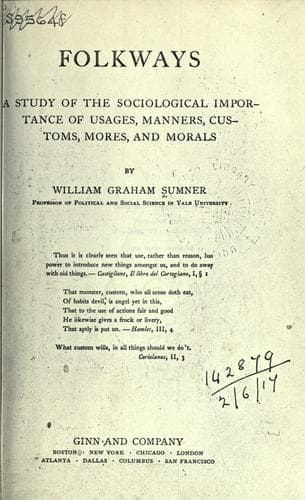
Folkways: A Study of the Sociological Importance of Usages, Manners, Customs, Mores, and MoralsSumner, William Graham
General
Folkways: A Study of the Sociological Importance of Usages, Manners, Customs, Mores, and Morals
Sumner, William Graham
Manners and customs
+12. Tradition and its restraints.+ It is evident that the "ways" of the
older and more experienced members of a society deserve great authority
in any primitive group. We find that this rational authority leads to
customs of deference and to etiquette in favor of the old. The old in
turn cling stubbornly to tradition and to the example of their own
predecessors. Thus tradition and custom become intertwined and are a
strong coercion which directs the society upon fixed lines, and
strangles liberty. Children see their parents always yield to the same
custom and obey the same persons. They see that the elders are allowed
to do all the talking, and that if an outsider enters, he is saluted by
those who are at home according to rank and in fixed order. All this
becomes rule for children, and helps to give to all primitive customs
their stereotyped formality. "The fixed ways of looking at things which
are inculcated by education and tribal discipline, are the precipitate
of an old cultural development, and in their continued operation they
are the moral anchor of the Indian, although they are also the fetters
which restrain his individual will."[16]
+13. The concept of "primitive society"; we-group and others-group.+ The
conception of "primitive society" which we ought to form is that of
small groups scattered over a territory. The size of the groups is
determined by the conditions of the struggle for existence. The internal
organization of each group corresponds to its size. A group of groups
may have some relation to each other (kin, neighborhood, alliance,
connubium and commercium) which draws them together and differentiates
them from others. Thus a differentiation arises between ourselves, the
we-group, or in-group, and everybody else, or the others-groups,
out-groups. The insiders in a we-group are in a relation of peace,
order, law, government, and industry, to each other. Their relation to
all outsiders, or others-groups, is one of war and plunder, except so
far as agreements have modified it. If a group is exogamic, the women in
it were born abroad somewhere. Other foreigners who might be found in it
are adopted persons, guest friends, and slaves.
Public-domain text, read in full here on John Shaqi.
Reviews
Reviews
No reviews yet
Be the first to share your thoughts on this work.
Join the Discussion
Join the discussion
Sign in to leave a comment or review.
Sign InorCreate an account