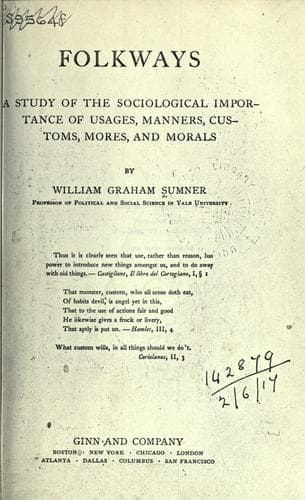
Folkways: A Study of the Sociological Importance of Usages, Manners, Customs, Mores, and MoralsSumner, William Graham
General
Folkways: A Study of the Sociological Importance of Usages, Manners, Customs, Mores, and Morals
Sumner, William Graham
Manners and customs
+14. Sentiments in the in-group and towards the out-group.+ The relation
of comradeship and peace in the we-group and that of hostility and war
towards others-groups are correlative to each other. The exigencies of
war with outsiders are what make peace inside, lest internal discord
should weaken the we-group for war. These exigencies also make
government and law in the in-group, in order to prevent quarrels and
enforce discipline. Thus war and peace have reacted on each other and
developed each other, one within the group, the other in the intergroup
relation. The closer the neighbors, and the stronger they are, the
intenser is the warfare, and then the intenser is the internal
organization and discipline of each. Sentiments are produced to
correspond. Loyalty to the group, sacrifice for it, hatred and contempt
for outsiders, brotherhood within, warlikeness without,--all grow
together, common products of the same situation. These relations and
sentiments constitute a social philosophy. It is sanctified by
connection with religion. Men of an others-group are outsiders with
whose ancestors the ancestors of the we-group waged war. The ghosts of
the latter will see with pleasure their descendants keep up the fight,
and will help them. Virtue consists in killing, plundering, and
enslaving outsiders.
+15. Ethnocentrism+ is the technical name for this view of things in
which one's own group is the center of everything, and all others are
scaled and rated with reference to it. Folkways correspond to it to
cover both the inner and the outer relation. Each group nourishes its
own pride and vanity, boasts itself superior, exalts its own divinities,
and looks with contempt on outsiders. Each group thinks its own folkways
the only right ones, and if it observes that other groups have other
folkways, these excite its scorn. Opprobrious epithets are derived from
these differences. "Pig-eater," "cow-eater," "uncircumcised,"
"jabberers," are epithets of contempt and abomination. The Tupis called
the Portuguese by a derisive epithet descriptive of birds which have
feathers around their feet, on account of trousers.[17] For our present
purpose the most important fact is that ethnocentrism leads a people to
exaggerate and intensify everything in their own folkways which is
peculiar and which differentiates them from others. It therefore
strengthens the folkways.
Public-domain text, read in full here on John Shaqi.
Reviews
Reviews
No reviews yet
Be the first to share your thoughts on this work.
Join the Discussion
Join the discussion
Sign in to leave a comment or review.
Sign InorCreate an account