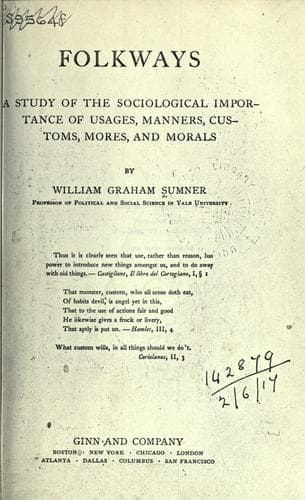
Folkways: A Study of the Sociological Importance of Usages, Manners, Customs, Mores, and MoralsSumner, William Graham
General
Folkways: A Study of the Sociological Importance of Usages, Manners, Customs, Mores, and Morals
Sumner, William Graham
Manners and customs
+16. Illustrations of ethnocentrism.+ The Papuans on New Guinea
are broken up into village units which are kept separate by
hostility, cannibalism, head hunting, and divergences of language
and religion. Each village is integrated by its own language,
religion, and interests. A group of villages is sometimes united
into a limited unity by connubium. A wife taken inside of this
group unit has full status; one taken outside of it has not. The
petty group units are peace groups within and are hostile to all
outsiders.[18] The Mbayas of South America believed that their
deity had bidden them live by making war on others, taking their
wives and property, and killing their men.[19]
+17.+ When Caribs were asked whence they came, they answered, "We
alone are people."[20] The meaning of the name Kiowa is "real or
principal people."[21] The Lapps call themselves "men," or "human
beings."[22] The Greenland Eskimo think that Europeans have been
sent to Greenland to learn virtue and good manners from the
Greenlanders. Their highest form of praise for a European is that
he is, or soon will be, as good as a Greenlander.[23] The
Tunguses call themselves "men."[24] As a rule it is found that
nature peoples call themselves "men." Others are something
else--perhaps not defined--but not real men. In myths the origin
of their own tribe is that of the real human race. They do not
account for the others. The Ainos derive their name from that of
the first man, whom they worship as a god. Evidently the name of
the god is derived from the tribe name.[25] When the tribal name
has another sense, it is always boastful or proud. The Ovambo
name is a corruption of the name of the tribe for themselves,
which means "the wealthy."[26] Amongst the most remarkable people
in the world for ethnocentrism are the Seri of Lower California.
They observe an attitude of suspicion and hostility to all
outsiders, and strictly forbid marriage with outsiders.[27]
Public-domain text, read in full here on John Shaqi.
Reviews
Reviews
No reviews yet
Be the first to share your thoughts on this work.
Join the Discussion
Join the discussion
Sign in to leave a comment or review.
Sign InorCreate an account