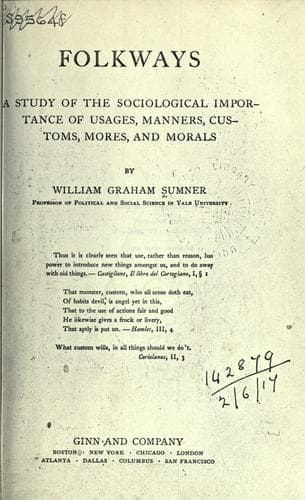
Folkways: A Study of the Sociological Importance of Usages, Manners, Customs, Mores, and MoralsSumner, William Graham
General
Folkways: A Study of the Sociological Importance of Usages, Manners, Customs, Mores, and Morals
Sumner, William Graham
Manners and customs
+18.+ The Jews divided all mankind into themselves and Gentiles.
They were the "chosen people." The Greeks and Romans called all
outsiders "barbarians." In Euripides' tragedy of _Iphigenia in
Aulis_ Iphigenia says that it is fitting that Greeks should rule
over barbarians, but not contrariwise, because Greeks are free,
and barbarians are slaves. The Arabs regarded themselves as the
noblest nation and all others as more or less barbarous.[28] In
1896, the Chinese minister of education and his counselors edited
a manual in which this statement occurs: "How grand and glorious
is the Empire of China, the middle kingdom! She is the largest
and richest in the world. The grandest men in the world have all
come from the middle empire."[29] In all the literature of all
the states equivalent statements occur, although they are not so
naively expressed. In Russian books and newspapers the civilizing
mission of Russia is talked about, just as, in the books and
journals of France, Germany, and the United States, the
civilizing mission of those countries is assumed and referred to
as well understood. Each state now regards itself as the leader
of civilization, the best, the freest, and the wisest, and all
others as inferior. Within a few years our own
man-on-the-curbstone has learned to class all foreigners of the
Latin peoples as "dagos," and "dago" has become an epithet of
contempt. These are all cases of ethnocentrism.
Public-domain text, read in full here on John Shaqi.
Reviews
Reviews
No reviews yet
Be the first to share your thoughts on this work.
Join the Discussion
Join the discussion
Sign in to leave a comment or review.
Sign InorCreate an account