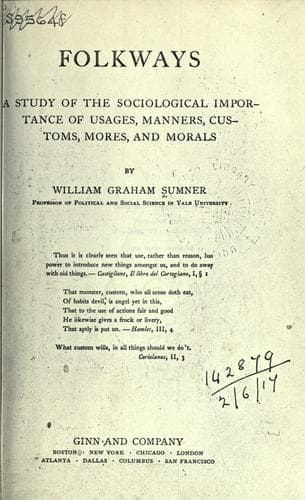
Folkways: A Study of the Sociological Importance of Usages, Manners, Customs, Mores, and MoralsSumner, William Graham
General
Folkways: A Study of the Sociological Importance of Usages, Manners, Customs, Mores, and Morals
Sumner, William Graham
Manners and customs
+19. Patriotism+ is a sentiment which belongs to modern states.
It stands in antithesis to the mediaeval notion of catholicity.
Patriotism is loyalty to the civic group to which one belongs by
birth or other group bond. It is a sentiment of fellowship and
cooperation in all the hopes, work, and suffering of the group.
Mediaeval catholicity would have made all Christians an in-group
and would have set them in hostility to all Mohammedans and other
non-Christians. It never could be realized. When the great modern
states took form and assumed control of societal interests, group
sentiment was produced in connection with those states. Men
responded willingly to a demand for support and help from an
institution which could and did serve interests. The state drew
to itself the loyalty which had been given to men (lords), and it
became the object of that group vanity and antagonism which had
been ethnocentric. For the modern man patriotism has become one
of the first of duties and one of the noblest of sentiments. It
is what he owes to the state for what the state does for him, and
the state is, for the modern man, a cluster of civic institutions
from which he draws security and conditions of welfare. The
masses are always patriotic. For them the old ethnocentric
jealousy, vanity, truculency, and ambition are the strongest
elements in patriotism. Such sentiments are easily awakened in a
crowd. They are sure to be popular. Wider knowledge always proves
that they are not based on facts. That we are good and others are
bad is never true. By history, literature, travel, and science
men are made cosmopolitan. The selected classes of all states
become associated; they intermarry. The differentiation by states
loses importance. All states give the same security and
conditions of welfare to all. The standards of civic institutions
are the same, or tend to become such, and it is a matter of pride
in each state to offer civic status and opportunities equal to
the best. Every group of any kind whatsoever demands that each of
its members shall help defend group interests. Every group
stigmatizes any one who fails in zeal, labor, and sacrifices for
group interests. Thus the sentiment of loyalty to the group, or
the group head, which was so strong in the Middle Ages, is kept
up, as far as possible, in regard to modern states and
governments. The group force is also employed to enforce the
obligations of devotion to group interests. It follows that
judgments are precluded and criticism is silenced.
Public-domain text, read in full here on John Shaqi.
Reviews
Reviews
No reviews yet
Be the first to share your thoughts on this work.
Join the Discussion
Join the discussion
Sign in to leave a comment or review.
Sign InorCreate an account