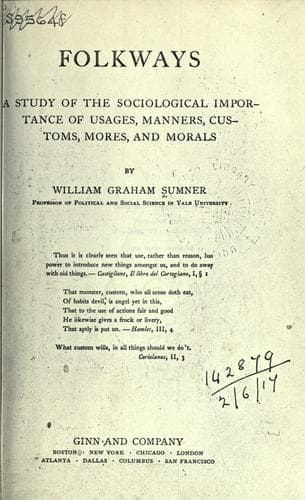
Folkways: A Study of the Sociological Importance of Usages, Manners, Customs, Mores, and MoralsSumner, William Graham
General
Folkways: A Study of the Sociological Importance of Usages, Manners, Customs, Mores, and Morals
Sumner, William Graham
Manners and customs
+20. Chauvinism.+ That patriotism may degenerate into a vice is
shown by the invention of a name for the vice: chauvinism. It is
a name for boastful and truculent group self-assertion. It
overrules personal judgment and character, and puts the whole
group at the mercy of the clique which is ruling at the moment.
It produces the dominance of watchwords and phrases which take
the place of reason and conscience in determining conduct. The
patriotic bias is a recognized perversion of thought and judgment
against which our education should guard us.
+21. The struggle for existence and the competition of life;
antagonistic cooperation.+ The struggle for existence must be carried on
under life conditions and in connection with the competition of life.
The life conditions consist in variable elements of the environment, the
supply of materials necessary to support life, the difficulty of
exploiting them, the state of the arts, and the circumstances of
physiography, climate, meteorology, etc., which favor life or the
contrary. The struggle for existence is a process in which an individual
and nature are the parties. The individual is engaged in a process by
which he wins from his environment what he needs to support his
existence. In the competition of life the parties are men and other
organisms. The men strive with each other, or with the flora and fauna
with which they are associated. The competition of life is the rivalry,
antagonism, and mutual displacement in which the individual is involved
with other organisms by his efforts to carry on the struggle for
existence for himself. It is, therefore, the competition of life which
is the societal element, and which produces societal organization. The
number present and in competition is another of the life conditions. At
a time and place the life conditions are the same for a number of human
beings who are present, and the problems of life policy are the same.
This is another reason why the attempts to satisfy interest become mass
phenomena and result in folkways. The individual and social elements are
always in interplay with each other if there are a number present. If
one is trying to carry on the struggle for existence with nature, the
fact that others are doing the same in the same environment is an
essential condition for him. Then arises an alternative. He and the
others may so interfere with each other that all shall fail, or they may
combine, and by cooperation raise their efforts against nature to a
higher power. This latter method is industrial organization. The crisis
which produces it is constantly renewed, and men are forced to raise the
organization to greater complexity and more comprehensive power, without
limit. Interests are the relations of action and reaction between the
individual and the life conditions, through which relations the
evolution of the individual is produced. That evolution, so long as it
Public-domain text, read in full here on John Shaqi.
Reviews
Reviews
No reviews yet
Be the first to share your thoughts on this work.
Join the Discussion
Join the discussion
Sign in to leave a comment or review.
Sign InorCreate an account