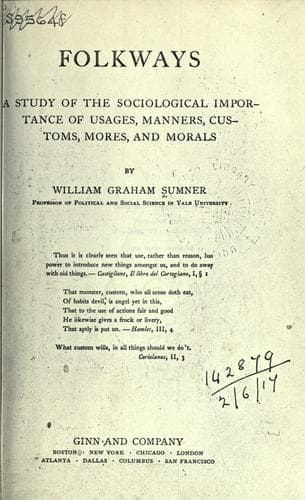
Folkways: A Study of the Sociological Importance of Usages, Manners, Customs, Mores, and MoralsSumner, William Graham
General
Folkways: A Study of the Sociological Importance of Usages, Manners, Customs, Mores, and Morals
Sumner, William Graham
Manners and customs
goes on prosperously, is well living, and it results in the
self-realization of the individual, for we may think of each one as
capable of fulfilling some career and attaining to some character and
state of power by the developing of predispositions which he possesses.
It would be an error, however, to suppose that all nature is a chaos of
warfare and competition. Combination and cooperation are so
fundamentally necessary that even very low life forms are found in
symbiosis for mutual dependence and assistance. A combination can exist
where each of its members would perish. Competition and combination are
two forms of life association which alternate through the whole organic
and superorganic domains. The neglect of this fact leads to many
socialistic fallacies. Combination is of the essence of organization,
and organization is the great device for increased power by a number of
unequal and dissimilar units brought into association for a common
purpose. McGee[30] says of the desert of Papagueria, in southwestern
Arizona, that "a large part of the plants and animals of the desert
dwell together in harmony and mutual helpfulness [which he shows in
detail]; for their energies are directed not so much against one another
as against the rigorous environmental conditions growing out of dearth
of water. This communality does not involve loss of individuality, ...
indeed the plants and animals are characterized by an individuality
greater than that displayed in regions in which perpetuity of the
species depends less closely on the persistence of individuals." Hence
he speaks of the "solidarity of life" in the desert. "The saguaro is a
monstrosity in fact as well as in appearance,--a product of
miscegenation between plant and animal, probably depending for its form
of life history, if not for its very existence, on its commensals."[31]
The Seri protect pelicans from themselves by a partial taboo, which is
not understood. It seems that they could not respect a breeding time, or
establish a closed season, yet they have such an appetite for the birds
and their eggs that they would speedily exterminate them if there were
no restraint. This combination has been well called antagonistic
cooperation. It consists in the combination of two persons or groups to
satisfy a great common interest while minor antagonisms of interest
which exist between them are suppressed. The plants and animals of the
desert are rivals for what water there is, but they combine as if with
an intelligent purpose to attain to a maximum of life under the
conditions. There are many cases of animals who cooperate in the same
way. Our farmers put crows and robins under a protective taboo because
the birds destroy insects. The birds also destroy grain and fruits, but
this is tolerated on account of their services. Madame Pommerol says of
the inhabitants of Sahara that the people of the towns and the nomads
are enemies by caste and race, but allies in interest. The nomads need
Public-domain text, read in full here on John Shaqi.
Reviews
Reviews
No reviews yet
Be the first to share your thoughts on this work.
Join the Discussion
Join the discussion
Sign in to leave a comment or review.
Sign InorCreate an account