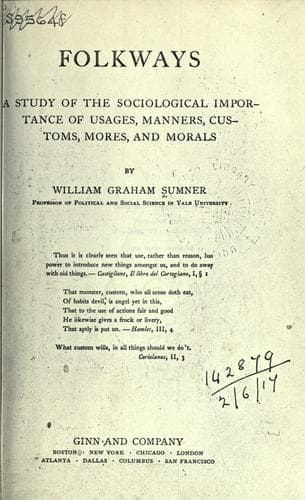
Folkways: A Study of the Sociological Importance of Usages, Manners, Customs, Mores, and MoralsSumner, William Graham
General
Folkways: A Study of the Sociological Importance of Usages, Manners, Customs, Mores, and Morals
Sumner, William Graham
Manners and customs
refuge and shelter. The townspeople need messengers and transportation.
Hence ties of contract, quarrels, fights, raids, vengeances, and
reconciliations for the sake of common enterprises of plunder.[32]
Antagonistic cooperation is the most productive form of combination in
high civilization. It is a high action of the reason to overlook lesser
antagonisms in order to work together for great interests. Political
parties are constantly forced to do it. In the art of the statesman it
is a constant policy. The difference between great parties and factions
in any parliamentary system is of the first importance; that difference
consists in the fact that parties can suppress minor differences, and
combine for what they think most essential to public welfare, while
factions divide and subdivide on petty differences. Inasmuch as the
suppression of minor differences means a suppression of the emotional
element, while the other policy encourages the narrow issues in regard
to which feeling is always most intense, the former policy allows far
less play to feeling and passion.
+22. Hunger, love, vanity, and fear.+ There are four great motives of
human action which come into play when some number of human beings are
in juxtaposition under the same life conditions. These are hunger, sex
passion, vanity, and fear (of ghosts and spirits). Under each of these
motives there are interests. Life consists in satisfying interests, for
"life," in a society, is a career of action and effort expended on both
the material and social environment. However great the errors and
misconceptions may be which are included in the efforts, the purpose
always is advantage and expediency. The efforts fall into parallel
lines, because the conditions and the interests are the same. It is now
the accepted opinion, and it may be correct, that men inherited from
their beast ancestors psychophysical traits, instincts, and dexterities,
or at least predispositions, which give them aid in solving the problems
of food supply, sex, commerce, and vanity. The result is mass phenomena;
currents of similarity, concurrence, and mutual contribution; and these
produce folkways. The folkways are unconscious, spontaneous,
uncoordinated. It is never known who led in devising them, although we
must believe that talent exerted its leadership at all times. Folkways
come into existence now all the time. There were folkways in stage coach
times, which were fitted to that mode of travel. Street cars have
produced ways which are suited to that mode of transportation in cities.
The telephone has produced ways which have not been invented and imposed
by anybody, but which are devised to satisfy conveniently the interests
which are at stake in the use of that instrument.
Public-domain text, read in full here on John Shaqi.
Reviews
Reviews
No reviews yet
Be the first to share your thoughts on this work.
Join the Discussion
Join the discussion
Sign in to leave a comment or review.
Sign InorCreate an account