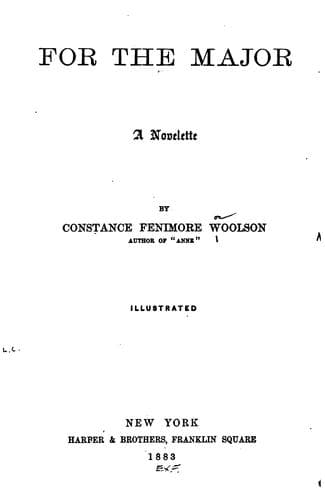
For the Major: A NoveletteWoolson, Constance Fenimore
General
For the Major: A Novelette
Woolson, Constance Fenimore
Psychological fiction; United States -- Social life and customs -- 19th century -- Fiction
It was odious on account of the presence of a stranger who had appeared
in Far Edgerley three weeks before, a stranger who had made his way into
society there with so much rapidity and success that he had now
penetrated even the exclusive barriers of the Farms. But this
phraseology was Miss Carroll's. In reality, the stranger's "way" had not
been made by any effort of his own, but rather by his manners and
appearance, which were original, and more especially by a gift for which
nature was responsible, not himself. And as to "penetrating the
barriers" of the Farms, he had not shown any especial interest in that
old-fashioned mansion, and now that he was actually there, and at one of
the receptions, too, he seemed not impressed by his good fortune, but
wandered about rather restlessly, and yawned a good deal in corners.
These little ways of his, however, were considered to belong to the
"fantasies of genius;" Madam Carroll herself had so characterized them.
The stranger had, indeed, unlimited genius, if signs of this kind were
to be taken as evidences of it; he interrupted people in the middle of
their sentences; he left them abruptly while they were still talking to
him; he yawned (as has already been mentioned), and not always in
corners; he went to see the persons he fancied, whether they had asked
him to do so or not; he never dreamed of going to see the persons he
did not fancy, no matter how many times they had invited him. He had a
liking for flower-gardens, and had been discovered more than once, soon
after his arrival, sitting in honeysuckle arbors which the owners had
supposed were for their own private enjoyment. When found, he had not
apologized; he had complimented the owners upon their honeysuckles.
Strangers were so rare in Far Edgerley--high, ancient little village in
the mountains, far from railways, unmentioned in guide-books--that this
admirer of flower-gardens was known by sight through all the town before
he had been two days in the place. He was named Dupont, and he was
staying at the village inn, the Washington Hotel--an old red brick
structure, whose sign, a weather-beaten portrait of the Father of his
Country, crowned the top of a thick blue pole set out in the middle of
Edgerley Street. He was apparently about twenty-eight or thirty years of
age, tall, slender, carelessly dressed, yet possessing, too, some
picturesque articles of attire to which Far Edgerley was not accustomed;
notably, low shoes with red silk stockings above them, and a red silk
handkerchief to match the stockings peeping from the breast pocket of
the coat; a cream-colored umbrella lined with red silk; a quantity of
cream-colored gauze wound round a straw hat.
Public-domain text, read in full here on John Shaqi.
Reviews
Reviews
No reviews yet
Be the first to share your thoughts on this work.
Join the Discussion
Join the discussion
Sign in to leave a comment or review.
Sign InorCreate an account