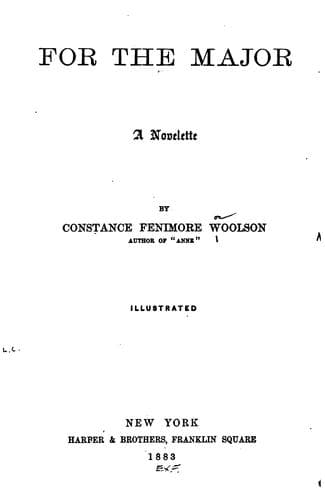
For the Major: A NoveletteWoolson, Constance Fenimore
General
For the Major: A Novelette
Woolson, Constance Fenimore
Psychological fiction; United States -- Social life and customs -- 19th century -- Fiction
But it was not these articles, remarkable as they were, nor his taste
for opening gates without permission, nor his habit of walking in the
middle of the street, ignoring sidewalks, nor another habit he had of
rising and going out of church just before the sermon--it was none of
these which had given him his privilege of entering "the best society."
The best society had opened its doors to Genius, and to Genius alone.
This genius was of the musical kind. Dupont played and sang his own
compositions. "What," said Madam Carroll, "is genius, if not this?"
Madam Carroll's opinion was followed in Far Edgerley, and Dupont now had
the benefit of it. The Rendleshams invited him to tea; the Greers sang
for him; he was offered the _Saturday Review_; even Mrs. General
Hibbard, joining the gentle tide, invited him to Chapultepec, and when
he came, showed him the duck yard. Miss Honoria Ashley did not yield to
the current. But then Miss Honoria never yielded to anything. Her
father, the junior warden, freely announced (outside his own gate) that
the "singing man" amused him. Mr. Phipps hated him, but that was because
Dupont had shown some interest in Miss Lucy Rendlesham, who was pretty.
Not that they cared much, however, for beauty in Far Edgerley; it was
so much better to be intellectual. Ferdinand Kenneway, when he learned
that the new-comer had been received both at Chapultepec and the Farms,
called at the inn, and left one of his engraved cards--"Mr. F. Kenneway,
Baltimore." He had once lived in Baltimore six months. Dupont made an
excellent caricature of Ferdinand on the back of the card, and never
returned the call. On the whole, the musician had reason to congratulate
himself upon so complete a conquest of Far Edgerley's highest circle.
Only two persons (besides Phipps) in all that circle disliked him. True,
these two disliked him strongly; but they remained only two, and they
were, in public, at least, silent. They were Miss Carroll and the rector
of St. John's.
Perhaps it was but natural that a clergyman should look askance at a man
who always rose and walked out of church at the very moment when he was
preparing to begin his sermon. Miss Carroll, however, had no such
sufficient reason to give for her dislike; when Dupont came to the Farms
he was as respectfully polite to her as he could be in the very small
opportunity she vouchsafed him. He came often to their flower-garden.
She complained of his constant presence. "I am never sure that he is not
there. He is either lying at full length in the shade of the
rhododendrons, or else sitting in the rose arbor, drumming on the
table."
"Very harmless amusements they seem to me," replied Madam Carroll.
"Yes. But why should we be compelled to provide his amusements? I think
that office we might decline."
"You are rather unkind, aren't you? What harm has the poor fellow done
to us?"
"Oh, if you are going to pity him, mamma--"
Public-domain text, read in full here on John Shaqi.
Reviews
Reviews
No reviews yet
Be the first to share your thoughts on this work.
Join the Discussion
Join the discussion
Sign in to leave a comment or review.
Sign InorCreate an account