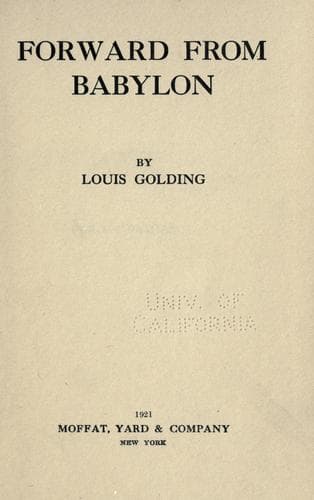
England, Northern -- Fiction; Fathers and sons -- Fiction; Jews -- Fiction
"Of course she died! What then? And thy mother also, over a hundred
years! She too! But why must thou talk about Death like this, thou
not thirteen yet? Wait till thou art older and thou hast a wife and
family and hast married a son and a daughter, then it will be time!
But for thy Lady, she's only a story, so of course she's dead! How
else?"
"Ah, that's where you're wrong, see! Shelley knows all about it. He
makes you feel awfully miserable and then he comes back right at the
very end:
_That garden sweet, that lady fair,
And all sweet shapes and odours there,
In truth have never past away!
'Tis we, 'tis ours, are changed; not they._
I suppose all that's what Harry means by 'philosophy.' Anyhow, that's
not the part I like so much. What d'you think of this?
_... Narcissi, the fairest among them all
Who gaze on their eyes in the stream's recess
Till they die of their own dear loveliness."_
"What does thy mother think of it? My head's aching; what can I
understand thereof?"
"Oh yes, you can understand it right enough! You understand it better
than I do, but you don't want to show off! But listen ... Oh, where's
that Shelley Channah bought me? Good, here it is! Listen to this
now!" And he ran through another poem recently discovered. This
reading and chanting would take place daily. Mrs. Massel sat on the
sofa bewildered by this spate of melody, but keenly happy in the
enthusiasm of her son. If she ever ventured a "Philip, but not one
word do I understand!" "Ah! what does that matter?" Philip replied.
"Do you remember when I asked _tatte_ what good I would do to God by
saying a lot of prayers I can't understand a bit about--you remember,
he was in a good temper?--he answered that it didn't matter if you
can't understand; it's so holy to say things in Hebrew that God likes
it just the same. Well, there you are, it's just poetry! It's like
singing, only much finer!"
Sometimes he would get her to repeat lines after him. She might make a
feeble attempt to remonstrate with him, but saw that her humorous
efforts made him so beam with delight, that awkwardly, with an entirely
false distribution of accents and meanings, she stammered out her
lines. It was "Arethusa" finally brought this diversion to an end.
"From her couch of snows," said Philip. She made an effort to imitate
him.
"In the Acroceraunian mountains."
"In de Ac--ac--ac ... It cannot be, Feivel. I can't!"
"In the Ac--ro--ce--rau--nian mountains."
"Ac--roc--Ac--roc--roc-- No, Feivel, my teeth! Tell me all the rest
thyself, I will listen; it will be better so! I cannot thy croc--croc!"
When at last the feet of Reb Monash were heard in the bedroom overhead,
the poetry séance came abruptly to an end. Mrs. Massel turned to the
fire to put on the kettle for his pre-_chayder_ tea. Philip
regretfully hid away his poet and turned to the intricacies of algebra.
Public-domain text, read in full here on John Shaqi.
Reviews
Reviews
No reviews yet
Be the first to share your thoughts on this work.
Join the Discussion
Join the discussion
Sign in to leave a comment or review.
Sign InorCreate an account