Fossil Forests of the Yellowstone National ParkKnowlton, Frank Hall
Science
Fossil Forests of the Yellowstone National Park
Knowlton, Frank Hall
Paleobotany -- Yellowstone National Park; Petrified forests; Trees, Fossil -- Yellowstone National Park
Above this cliff fossil trunks appear in great numbers and in regular
succession. As they are all perfectly silicified, they are more
resistant than the surrounding matrix and consequently stand above it.
Most of them are only a few inches above the surface, but occasionally
one rises as high as 5 or 6 feet. The largest trunk observed in the park
is found in this locality. It is a little over 10 feet in diameter, a
measurement that includes a part of the bark. It is very much broken
down, especially in the interior, probably having been so disintegrated
before it was fossilized. It projects about 6 feet above the surface.
At many places about Amethyst Mountain there are numerous fragments of
fossil wood and many hollow trunks. The material in which they had been
embedded has been eroded away, and they lie around in somewhat the same
attitudes that are shown by all the trunks in the Arizona fossil
forests, but there is little doubt that they were originally erect and
have simply fallen by their own weight because of the removal of the
material around them.
Many of the trunks here, as well as elsewhere in the park, had decayed
in the center before they were fossilized, and some of the hollow
interiors are filled with clusters and rosettes of beautiful crystals of
amethyst, which doubtless suggested the name given to the adjacent
mountain. Much of this finely preserved wood, as well as the trunks
containing the crystals of amethyst, was broken up and carried away by
collectors of minerals and curiosities before the Government control in
the park was made sufficiently rigid to insure proper protection.
SPECIMEN RIDGE.
In many respects the most remarkable of the fossil forests is on the
northwest end of Specimen Ridge, about a mile southeast of Junction
Butte and about opposite the mouth of Slough Creek. So far as known,
this forest was first brought to scientific attention by Mr. E. C.
Alderson, of Bozeman, Mont., and the writer, who discovered it in
August, 1887. It is found on the higher part of the ridge, and covers
several acres. The trees are exposed at various heights on the very
steep hillsides, and one remarkable feature of the forest is that most
of them project well above the surface.
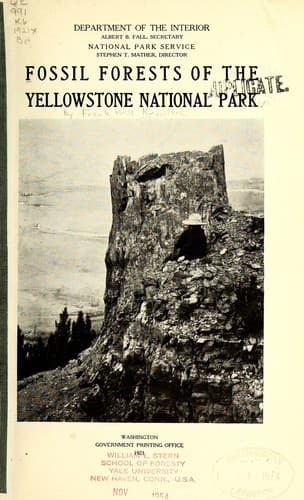
One of the largest and best preserved trees stands at the very summit of
the slope (see title page). This trunk, which is that of a giant
redwood, is 26½ feet in circumference without the bark and about 12 feet
in height. The portion of this huge trunk preserved is the base, and it
exhibits to a considerable degree the swelling or buttressing so well
known in the living redwood. The roots, which are as large as the trunks
of ordinary trees, are now embedded in solid rock.
[Illustration: Fig. 5.—Upright trunks in Specimen Ridge fossil
forest.]
Public-domain text, read in full here on John Shaqi.
Reviews
Reviews
No reviews yet
Be the first to share your thoughts on this work.
Join the Discussion
Join the discussion
Sign in to leave a comment or review.
Sign InorCreate an account