Fossil Forests of the Yellowstone National Park — John Shaqi
Fossil Forests of the Yellowstone National ParkKnowlton, Frank Hall
Science
Fossil Forests of the Yellowstone National Park
Knowlton, Frank Hall
Paleobotany -- Yellowstone National Park; Petrified forests; Trees, Fossil -- Yellowstone National Park
On the steep hillside a short distance below the big tree just mentioned
are the two trunks shown in figure 5. They are about 2 feet in diameter
and 25 feet high, and stand some 20 feet apart, and we may imagine them
to have formed the doorposts of the “ancient temple” of which Holmes
speaks. Both these trunks are without the bark. On the left of the
figure is one of the huge irregular masses of rock that has been carved
out by erosion.
[Illustration: Fig. 6.—Trunk of fossil pine showing bark. Specimen
Ridge fossil forest.]
In figure 6 is shown another trunk about 3 feet in diameter and nearly
30 feet high. In several places along the trunk the thick bark may be
noted. This tree is a pine, as are the two last described, and slightly
below and behind it are two living pine trees, which are about the size
it must have been when living. Another trunk, some 12 feet in height, is
shown in figure 7, and in figure 8 there may be noted a standing trunk
and above it another that has recently fallen.
[Illustration: Fig. 7.—Trunk showing bark. Specimen Ridge fossil
forest.]
[Illustration: Fig. 8.—Upright and prostrate trunks, Specimen Ridge
fossil forest.]
The height attained by the trees of this fossil forest can not be
ascertained with certainty, since the tallest trunk now standing is only
about 30 feet high, but every one observed is obviously broken off, and
does not show even the presence of limbs. Perhaps the nearest approach
to a measure of the height is afforded by a trunk (shown in fig. 10)
that happened to have been prostrated before fossilization. This trunk,
which is 4 feet in diameter, is exposed for a length of about 40 feet,
and as it shows no apparent diminution in size within this distance it
is safe to assume that the tree could hardly have been less than 100
feet high and very probably may have been higher. This trunk is
wonderfully preserved. As may be seen from the illustration, it has
broken up by splitting along the grain of the wood into great numbers of
little pieces, which closely resemble pieces of “kindling wood” split
from a clear-grained block. In fact, at a distance of a few yards it
would be impossible to distinguish this fossil “kindling wood” from that
split from a living tree.
[Illustration: Fig. 10.—Prostrate trunk of fossil redwood, Specimen
Ridge fossil forest.]
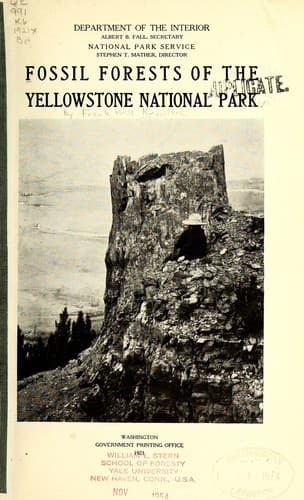
The large redwood trunk already mentioned (title-page) as being nearly
10 feet in diameter may be compared with its living relative of the
Pacific coast in order to calculate its probable height. The living
redwood is usually 10 to 15 feet in diameter and ranges in height from
200 to 310 feet, and as the two are so very closely related there is no
reason to suppose that the fossil trunk was of less height, but by a
moderate estimate it may be accredited with a minimum height of 200
feet.
Public-domain text, read in full here on John Shaqi.
Reviews
Reviews
No reviews yet
Be the first to share your thoughts on this work.
Join the Discussion
Join the discussion
Sign in to leave a comment or review.
Sign InorCreate an account