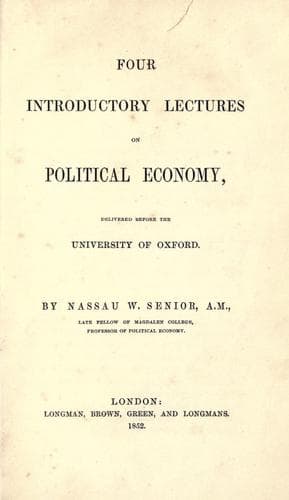
Four Introductory Lectures on Political EconomySenior, Nassau William
General
Four Introductory Lectures on Political Economy
Senior, Nassau William
Economics
With the exception, however, of poetry, architecture, and generally
of the arts that are addressed to the taste and the imagination,
for which nations in an early stage of civilisation seem to have a
peculiar aptitude, the arts of an unscientific age contain many rules
ineffectual for their intended purposes, and many that are positively
opposed to them. Thus the medicine of the middle ages ordered plants
with yellow flowers to be used in cases of jaundice, and those with
red flowers in fevers, and directed fomentations and ointments to be
applied not to the wound but to the sword. At length a man arrives
with wider views or less docile habits of mind, who is not satisfied
to obey what often appear to him to be arbitrary rules, though he is
told that they are the results of experience. He endeavours to account
for the effects which he sees produced, that is to say, to refer them
to some general laws of matter or of mind. To do this is to create
a science. As soon as scientific habits of thought prevail, men are
teazed by any appearance for which they cannot account. Their first
motive is to question its reality. Evidence of mesmeric clairvoyance
has been produced enough to satisfy a sceptical inquirer, if the
phenomenon itself could be accounted for. But we cannot refer it to any
general law, and therefore the greater part of those who think about
it, deny its existence; many suspend their opinion, and scarcely any
are complete believers. If its existence should ever be thoroughly
established, the whole scientific world will be engaged in searching
for the general principles to which it is to be referred; for no one
will be satisfied with accepting it as an insulated unexplained fact.
I have said that a single art generally draws its premises from many
different sciences. So a single science generally affords premises to
many different arts. How numerous are the sciences which are applicable
to the art of war. How numerous are the arts which depend in part on
the principles of chemistry. And it is obvious that every increase of
human knowledge must increase the influence of science on art. Under
this influence many new rules are laid down, and many, which were
supposed to be founded on experience, are abandoned as unnecessary
or injurious. The art becomes in some respects more simple and in
others more complex: more complex because its precepts become more
diversified and more detailed; more simple because, instead of being
thrown together with little apparent connection, they are grouped under
the general principles supplied by science.
Public-domain text, read in full here on John Shaqi.
Reviews
Reviews
No reviews yet
Be the first to share your thoughts on this work.
Join the Discussion
Join the discussion
Sign in to leave a comment or review.
Sign InorCreate an account