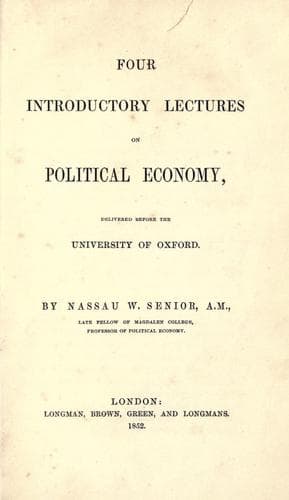
Four Introductory Lectures on Political EconomySenior, Nassau William
General
Four Introductory Lectures on Political Economy
Senior, Nassau William
Economics
The measure now[A] before parliament for introducing into Ireland a
compulsory provision for the destitute, is defended by an appeal to
experience. We are told that the English poor have such a provision,
and are the most industrious and the best maintained population in
Europe. The Irish poor have no such provision, and are the idlest
and the poorest people that is called civilised. If the presence of
a poor law in the one and its absence in the other were the only
difference in the history of the two countries, this would really be an
instance of experience. If a country with a previous history precisely
resembling that of England, possessing precisely the same physical and
moral advantages, and differing solely in the absence of a poor law,
were found to be idle and miserable, we might justly infer that the
prosperity of England is owing to its poor law; for there would be no
other cause to which it could be referred. And the misery of the other
country could be referred to no cause except its want of a poor law.
But when we find that the English and the Irish nations differ in race,
in religion, and in habits,--that the one is chiefly a town and the
other almost exclusively a country population,--that the one consists
principally of labourers for hire, the other of small tenants,--that
the one lives on wages, the other on its own crop,--that the vice of
the one is improvidence, that of the other indolence,--that in one
country the religion of the people has been persecuted, in the other
endowed,--that in the one the clergy of the people are the allies of
the government, in the other its enemies,--that in the one public
sympathy is with the supporter of order and peace, in the other with
the disturber,--that the code which prevails in the one is that which
is sanctioned by parliament and administered by courts of justice, in
the other is one framed by conspirators, promulgated by threatening
notices, and enforced by outrage and assassination,--that it is
more dangerous to obey the law in the one than to violate it in the
other,--when we find that these differences have lasted for centuries,
and that, almost from our earliest knowledge of them, the circumstances
in which the two countries have been placed have been not only
dissimilar but opposed, it is obvious that the wretchedness of Ireland
in the absence of a poor law does not prove that the presence of such
an institution has been beneficial to England. All that is proved is
that a country can prosper with a poor law and be miserable without
one. To that extent the experience of England and Ireland is decisive.
It is a complete answer to any one who should maintain either that a
country in which the population are forced to rely for subsistence on
their own resources will necessarily be laborious, or that one in which
the law protects every one, whatever be his conduct, from want, will
necessarily be indolent. But it is no answer to any one who should
Public-domain text, read in full here on John Shaqi.
Reviews
Reviews
No reviews yet
Be the first to share your thoughts on this work.
Join the Discussion
Join the discussion
Sign in to leave a comment or review.
Sign InorCreate an account