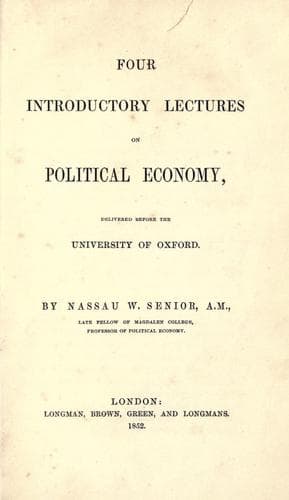
Four Introductory Lectures on Political EconomySenior, Nassau William
General
Four Introductory Lectures on Political Economy
Senior, Nassau William
Economics
maintain that such are the tendencies of the two opposite institutions,
but that such tendencies may be neutralised by counteracting causes.
And yet there are thousands of educated men who call such reasoning
as this arguing from experience, and are now anxious to make the
tremendous experiment of an Irish poor law on the English model in
reliance on what they call the experience of England.
[A] This Lecture was delivered in March, 1847.
When we direct our attention to the workings of our own minds, that is
to say, when we search for premises by means of consciousness instead
of by means of observation, our powers of trying experiments are much
greater. To a considerable degree we command our own faculties, and
though there are few, perhaps none, which we can use separately, we
can at will exercise one more vigorously than the others. We can call,
for instance, into peculiar activity, the judgment, the memory, or the
imagination, and note the differences in our mental condition as the
one faculty or the other is more active. And this is an experiment.
Over our mental sensations we have less power. We cannot at will feel
angry, or envious, or frightened. But we can sometimes, though rarely,
put ourselves really into situations by which certain emotions will
be excited. And when, as is usually the case, this is impossible or
objectionable, we can fancy ourselves in such situations. The first
is an actual experiment. We can approach the brink of an unprotected
precipice and look down. We can interpose between our bodies and that
brink a low parapet, and look over it. And if we find that our emotions
in the two cases differ,--that though there is no real danger in either
case, though in both our judgment equally tells us that we are safe,
yet that the apparent danger in the one produces fear, while we feel
secure in the other,--we infer that the imagination can excite fear for
which the judgment affirms that there is no adequate cause. The second
is the resemblance of an experiment, and when tried by a person with
the vivid imagination of Shakspeare or Homer may almost serve for one.
But with ordinary minds it is a most fallacious expedient. Few men when
they picture themselves in an imaginary situation take into account all
the incidents necessary to that situation. And those which they neglect
may be among the most important.
Having explained the distinction between a science and an art, and the
chief differences between the arts and sciences which consider as their
principal subject the laws of matter, and those whose principal subject
is mind, I now come to one of the practical questions in which this
long preface will I hope be found useful, namely, whether Political
Economy be a mental or a physical study.
Public-domain text, read in full here on John Shaqi.
Reviews
Reviews
No reviews yet
Be the first to share your thoughts on this work.
Join the Discussion
Join the discussion
Sign in to leave a comment or review.
Sign InorCreate an account