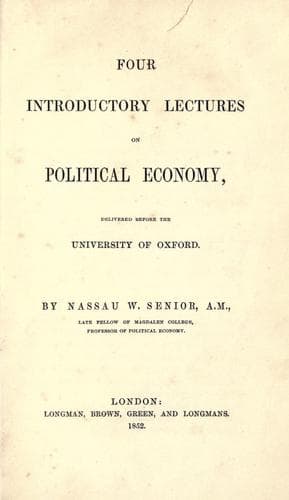
Four Introductory Lectures on Political EconomySenior, Nassau William
General
Four Introductory Lectures on Political Economy
Senior, Nassau William
Economics
Unquestionably the political economist has much to do with matter.
The phenomena attending the production of material wealth occupy a
great part of his attention; and these depend mainly on the laws of
matter. The efficacy of machinery, the diminishing productiveness,
under certain circumstances, of successive applications of capital to
land, and the fecundity and longevity of the human species, are all
important premises in Political Economy, and all are laws of matter.
But the political economist dwells on them only with reference to the
mental phenomena which they serve to explain; he considers them as
among the motives to the accumulation of capital, as among the sources
of rent, as among the regulators of profit, and as among the causes
which promote or retard the pressure of population on subsistence. If
the main subject of his studies were the physical phenomena attending
the production of wealth, a system of Political Economy must contain a
treatise on mechanics, on navigation, on agriculture, on chemistry--in
fact, on the subjects of almost all the physical sciences and arts,
for there are few of those arts or sciences which are not subservient
to wealth. All these details, however, the political economist avoids,
or uses a few of them sparingly for the purpose of illustration. He
does not attempt to state the mechanical and chemical laws which enable
the steam engine to perform its miracles--he passes them by as laws
of matter; but he explains, as fully as his knowledge will allow, the
motives which induce the mechanist to erect the steam engine, and
the labourer to work it. And these are laws of mind. He leaves to the
geologist to explain the laws of matter which occasion the formation
of coal, to the chemist to distinguish its component elements, to
the engineer to state the means by which it is extracted, and to the
teachers of many hundred different arts to point out the uses to which
it may be applied. What he reserves to himself is to explain the laws
of mind under which the owner of the soil allows his pastures to be
laid waste, and the minerals which they cover to be abstracted; under
which the capitalist employs, in sinking shafts and piercing galleries,
funds which might be devoted to his own immediate enjoyment; under
which the miner encounters the toils and the dangers of his hazardous
and laborious occupation; and the laws, also laws of mind, which
decide in what proportions the produce, or the value of the produce,
is divided between the three classes by whose concurrence it has been
obtained. When he uses as his premises, as he often must do, facts
supplied by physical science, he does not attempt to account for them;
he is satisfied with stating their existence. If he has to prove it,
he looks for his proofs, so far as he can, in the human mind. Thus the
economist need not explain why it is that labour cannot be applied to
a given extent of land to an indefinite amount with a proportionate
return.
Public-domain text, read in full here on John Shaqi.
Reviews
Reviews
No reviews yet
Be the first to share your thoughts on this work.
Join the Discussion
Join the discussion
Sign in to leave a comment or review.
Sign InorCreate an account