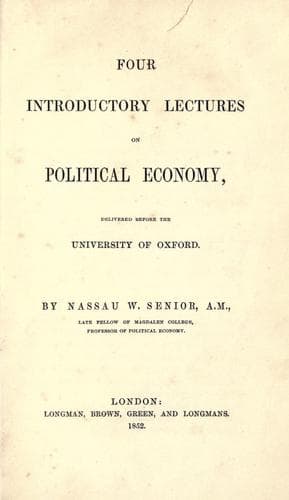
Four Introductory Lectures on Political EconomySenior, Nassau William
General
Four Introductory Lectures on Political Economy
Senior, Nassau William
Economics
He has done enough when he has proved that such is the fact;
and he proves this by showing, on the principles of human nature,
that, if it were otherwise, no land except that which is most fertile,
and best situated, would be cultivated. All the technical terms,
therefore, of Political Economy, represent either purely mental ideas,
such as _demand_, _utility_, _value_, and _abstinence_, or objects
which, though some of them may be material, are considered by the
political economist so far only as they are the results or the causes
of certain affections of the human mind, such as _wealth_, _capital_,
_rent_, _wages_, and _profits_.
In the next Lecture I shall consider the first of the two remaining
questions,--namely, whether Political Economy may be better treated as
a science or as an art.
LECTURE III.
REASONS FOR TREATING POLITICAL ECONOMY AS A SCIENCE.
In the following Lecture I shall consider whether Political Economy may
be better treated as a science or as an art.
If Political Economy is to be treated as a science, it may be defined
as “the science which states the laws regulating the production and
distribution of wealth, so far as they depend on the action of the
human mind.”
If it be treated as an art, it may be defined as “the art which points
out the institutions and habits most conducive to the production and
accumulation of wealth.” Or if the teacher venture to take a wider
view, as “the art which points out the institutions and habits most
conducive to that production, accumulation, and distribution of wealth,
which is most favourable to the happiness of mankind.”
Public-domain text, read in full here on John Shaqi.
Reviews
Reviews
No reviews yet
Be the first to share your thoughts on this work.
Join the Discussion
Join the discussion
Sign in to leave a comment or review.
Sign InorCreate an account