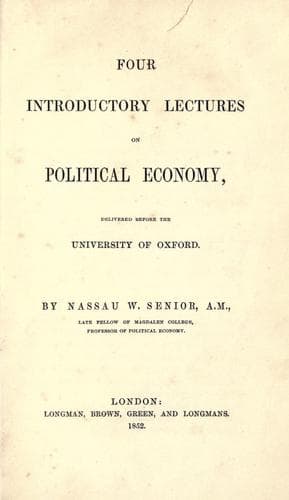
Four Introductory Lectures on Political EconomySenior, Nassau William
General
Four Introductory Lectures on Political Economy
Senior, Nassau William
Economics
According to the law which I have already mentioned, as regulating
the progress of knowledge, Political Economy, when, in the 17th
century, it first attracted notice as a subject of separate study,
was treated as an art. At that time human happiness was considered
as dependent chiefly on wealth, and wealth, as I have previously
remarked, was supposed to consist of gold and silver. The object which
the political economist proposed to himself and to his reader, was
the accumulation within his own country of the utmost possible amount
of the precious metals. The questions which now agitate society, as
to the distribution of wealth, were unregarded. All that was aimed
at, was its acquisition and retention in a metallic form. As respects
the countries possessing native deposits of the precious metals, the
means of effecting this were supposed to be obvious and easy. They had
only to promote the extraction of silver from mines, and that of gold
from auriferous sands, and to prohibit the exportation of either. This
was the policy of Spain and Portugal. The countries not possessing a
native supply, could obtain it only by what was called a favourable
balance of trade, that is to say, by exporting to a value exceeding
that of their imports, and receiving the difference in money. And
the money so acquired, they were taught to retain, by prohibiting
its exportation. The prevailing opinion shows itself in the preamble
of the 5 Rich. II. stat. 1. cap. 2., one among the many statutes and
proclamations by which this prohibition was for centuries enforced.
“For the great mischief which this realm suffereth, and long hath done,
for that gold and silver are carried out of the realm, so that, in
effect, there is none thereof left, which thing, if it should longer be
suffered, would shortly be the destruction of the same realm, which
God prohibit;” and the statute proceeds to forbid such exportation on
pain of forfeiture. The merchants, however, who were necessarily the
first to test the effects of this prohibition, found it inconvenient.
Some trades, particularly those with the East, could be carried on
only by the constant exportation of gold or silver, and in all others
it was occasionally useful. They did not venture to attack the theory
that the prosperity of a country depends on its accumulation of money.
Few of them, probably, doubted its truth. But they maintained that the
means by which the legislature endeavoured to promote this excellent
result, in fact defeated it. “Allow us,” they said, “to send out
silver to Asia, and we will bring back silks and calicos, not for our
own consumption, which of course would be a loss, but to sell on the
Continent for more silver than they cost, and we shall add annually to
the national treasure.” This was assented to, and after more than four
centuries of prohibition, the export of bullion was allowed by the 15
Car. II. cap. 17. “Forasmuch,” says the act, “as several considerable
Public-domain text, read in full here on John Shaqi.
Reviews
Reviews
No reviews yet
Be the first to share your thoughts on this work.
Join the Discussion
Join the discussion
Sign in to leave a comment or review.
Sign InorCreate an account