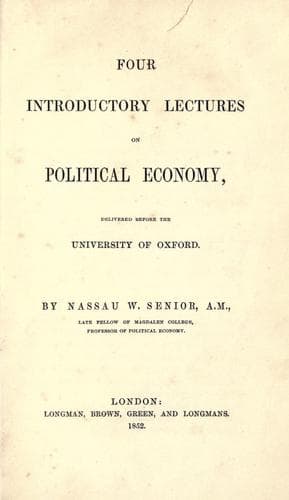
Four Introductory Lectures on Political EconomySenior, Nassau William
General
Four Introductory Lectures on Political Economy
Senior, Nassau William
Economics
foreign trades cannot be conveniently driven without the species of
money and bullion, and that it is found, by experience, that the
species of money and bullion are carried in greatest abundance, as to
a common market, to such places as give free liberty of exporting the
same, _and the better to keep in and increase the current coins of this
kingdom_, be it enacted, that it shall be lawful to export all sorts of
foreign coin and bullion, first entering the same at the custom-house.”
The art of Political Economy now became more complex. Its object,
indeed, was a very simple one, merely to increase the current coin of
the country; but this was to be effected, not by restraining every
trade which carried out bullion, but only those which carried out more
than they brought in. But how were such trades to be detected? A test
was supposed to be applied, by ascertaining whether their imports
were intended for home consumption, or for re-exportation. In the
former case, the trade, whether profitable or not to the merchant, was
obviously mischievous to the country.
In the second case the trade, if profitable to the merchant, must also
benefit the country, as it would receive more money than it sent out.
“It is not,” says Sir James Stewart[B], “by the importation of foreign
commodities, and by the exportation of gold and silver, that a nation
becomes poor; it is by consuming those commodities when imported. The
moment the consumption begins, the balance turns. Nations which trade
to India by sending out gold and silver for a return of superfluities
of a most consumable nature, the consumption of which they prohibit at
home, do not spend their own specie, but that of their neighbours, who
purchase the returns of it for their own consumption. Consequently a
nation may become immensely rich by the constant exportation of specie
and importation of consumable commodities. But she would do well to
beware not to resemble the milliner who took it into her head to wear
the fine laces which she used to make up for her customers. While a
favourable balance is preserved upon foreign trade, a nation grows
richer daily; and when one nation grows richer, others must be growing
poorer.”
[B] An Inquiry into the Principles of Political Economy, book
ii. ch. xxix. pp. 418, 419, and 422.
Public-domain text, read in full here on John Shaqi.
Reviews
Reviews
No reviews yet
Be the first to share your thoughts on this work.
Join the Discussion
Join the discussion
Sign in to leave a comment or review.
Sign InorCreate an account