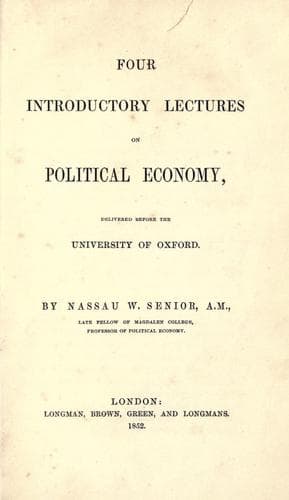
Four Introductory Lectures on Political EconomySenior, Nassau William
General
Four Introductory Lectures on Political Economy
Senior, Nassau William
Economics
Sir James Stewart’s work was published in 1767, and as he says that it
was the work of eighteen years, it must have been written between that
year and the year 1749. Though he calls Political Economy a science,
he treats it as an art, and has the merit of having first given to it
limits clearly separating it from the other moral and political arts.
“Its object is,” he says, “to secure a certain fund of subsistence for
all the inhabitants, to obviate every circumstance which may render
it precarious, to provide every thing necessary for supplying the
wants of the society, and to employ the inhabitants in such a manner
as naturally to create reciprocal relations and dependencies between
them, so as to make their several interests lead them to supply one
another with their reciprocal wants.”[C] This agrees with my second
proposal, namely, to define Political Economy as “the art which points
out the institutions and habits most conducive to the production and
accumulation of wealth.” As incidental to the art, he was forced to
examine the science, and a considerable portion of his work consists of
inquiries into the laws which regulate the production and distribution
of wealth. The extracts which I have read, show that he did not escape
the prevalent errors of his times. And these errors were so grave, as
to render the practical portion of his treatise not merely useless
for its intended purposes, but positively injurious. A legislator
following his precepts, would waste the wealth of the richest country,
and destroy the diligence of the most industrious. But the scientific
part of the work, particularly the chapters on population, and on the
influence of taxation on wages, contains truths of great importance,
which were unknown to his contemporaries, and cannot be said to be
generally recognised even now.
[C] Book I. Introduction.
Public-domain text, read in full here on John Shaqi.
Reviews
Reviews
No reviews yet
Be the first to share your thoughts on this work.
Join the Discussion
Join the discussion
Sign in to leave a comment or review.
Sign InorCreate an account