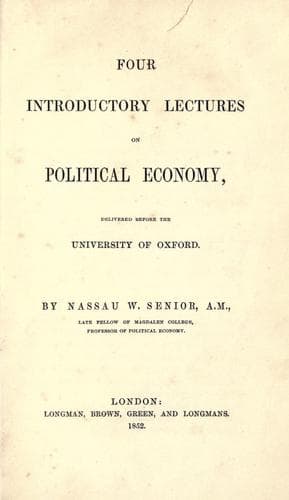
Four Introductory Lectures on Political EconomySenior, Nassau William
General
Four Introductory Lectures on Political Economy
Senior, Nassau William
Economics
Among the contemporaries of Stewart were the French Economists, or,
as they have lately been called, the Physiocrats, forming the school
founded by Quesnay. With the exception, however, of Turgot, they wrote
on the whole art of government. Their works, indeed, contain treatises
on Political Economy according to my third proposed definition, that
is to say, “on the institutions and habits most conducive to that
production, accumulation, and distribution of wealth, which is most
favourable to the happiness of mankind;” but they contain much more.
Quesnay and his followers lived in a country subject to political
institutions, of which many were mischievous, more were imperfect,
and all were unsettled. That the existing system of government was
bad, every one acknowledged. The economists believed that they had
discovered why it was bad. They believed that they had discovered that
agriculture is the only source of wealth, and rent the only legitimate
source of public revenue. And they proposed, therefore, to substitute
for the innumerable taxes on importation, on exportation, on transit,
on production, on sale, on consumption, and on the person of man, which
then formed the fiscal system of France, a single tax on the rent of
land. So far their precepts were founded on the science of Political
Economy. But when they proposed the separation of legislative and
judicial functions, and required the whole legislative power to center
in an absolute hereditary monarch, they drew their premises from other
branches of mental science. I have said that Turgot was an exception;
and it is remarkable, that the only man among the disciples of Quesnay
who was actually practising Political Economy as an art, is the only
one who treated its principles as a science. His “Réflexions sur la
Formation, et la Distribution des Richesses,” published in 1771, is
a purely scientific treatise. It contains not a word of precept; and
might have been written by an ascetic, who believed wealth to be an
evil.
Public-domain text, read in full here on John Shaqi.
Reviews
Reviews
No reviews yet
Be the first to share your thoughts on this work.
Join the Discussion
Join the discussion
Sign in to leave a comment or review.
Sign InorCreate an account