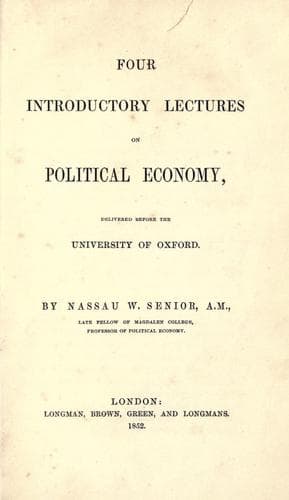
Four Introductory Lectures on Political Economy — John Shaqi
Four Introductory Lectures on Political EconomySenior, Nassau William
General
Four Introductory Lectures on Political Economy
Senior, Nassau William
Economics
We now come to Adam Smith, the founder of modern Political Economy,
whether it be treated as a science or as an art. He considered it as an
art. “Political Economy,” he says, in the introduction to the fourth
book, “proposes two distinct objects: first, to provide a plentiful
revenue or subsistence for the people, or, more properly, to enable
them to provide such a revenue or subsistence for themselves; and,
secondly, to supply the state or common weal with a revenue sufficient
for the public service. It proposes to enrich both the people and
the sovereign.” The principal purpose of his work was to show the
erroneousness of the means by which political economists had proposed
to attain these two great objects. And in the then state of knowledge,
this could be done only by proving that many of them mistook the nature
of wealth, and all of them the laws according to which it is produced
and distributed. The scientific portion of his work is merely an
introduction to that which is practical.
Of the five books into which the work is divided, it occupies only the
first and second. The third is an historical sketch of the progress of
national opulence. The fourth, the longest in the whole work, considers
the direct interferences by which governments have attempted to lead or
force their subjects to become rich; and decides, “that every system
which endeavours, either by extraordinary encouragements, to draw
towards a particular species of industry a greater share of the capital
of the society than would naturally go to it, or, by extraordinary
restraints, to force from a particular species of industry some share
of the capital which would otherwise be employed in it, is in reality
subversive of the great purpose which it means to promote. It retards,
instead of accelerating, the progress of the society towards real
wealth and greatness; and diminishes, instead of increasing, the real
value of the annual produce of its land and labour.”
“All systems,” he adds, “either of preference or of restraint,
therefore, being thus completely taken away, the obvious and simple
system of natural liberty establishes itself of its own accord.
According to that system, the sovereign has only three duties to
attend to: first, the duty of protecting the society from the violence
and invasion of other independent societies; secondly, the duty of
protecting, as far as possible, every member of the society from the
injustice or oppression of every other member of it, or the duty of
establishing an exact administration of justice; and, thirdly, the duty
of erecting and maintaining certain public works and certain public
institutions, which it can never be for the interest of any individual,
or small number of individuals, to erect and maintain.”
Public-domain text, read in full here on John Shaqi.
Reviews
Reviews
No reviews yet
Be the first to share your thoughts on this work.
Join the Discussion
Join the discussion
Sign in to leave a comment or review.
Sign InorCreate an account