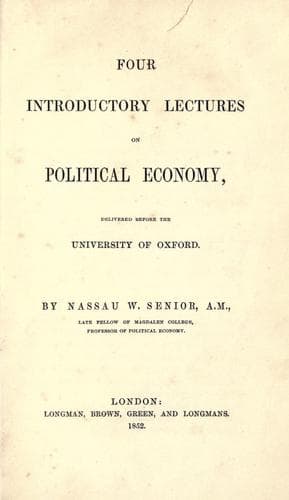
Four Introductory Lectures on Political EconomySenior, Nassau William
General
Four Introductory Lectures on Political Economy
Senior, Nassau William
Economics
The fifth book, which points out the means by which the duties of the
sovereign may best be performed, and the necessary public revenue
provided, is, in fact, a treatise on the art of government. It treats
of the subsidiary arts of war, of jurisprudence, and of education. It
considers the advantages and disadvantages of religious endowments,
and even the details of the opposed systems of patronage and popular
election, and of equality and inequality of benefices. It considers at
great length the modes and effects of taxation and of public loans, and
concludes by an elaborate plan for diminishing the taxation of Great
Britain, by requiring all the British dependencies, of which Ireland
and North America then formed part, to contribute directly to the
imperial treasury.
I have often doubted whether we ought not to wish that Adam Smith had
published his fifth book as a separate treatise with an appropriate
title. It is by far the most amusing and the easiest portion of the
“Wealth of Nations,” and must have attracted many readers whom the
abstractions of the first and second books, if they had formed a
separate work, would have repelled. On the other hand, the including
by so great an authority, in one treatise, and under one name, many
subjects belonging to different arts, has certainly contributed to the
indistinct views as to the nature and subjects of Political Economy,
which appear still to prevail.
The English writers who have succeeded Adam Smith, have generally set
out by defining Political Economy as a science, and proceeded to treat
it as an art.
Thus Mr. M‘Culloch states, as the proper subjects of Political Economy,
“the laws which regulate the production, accumulation, distribution,
and consumption of the articles or products possessing exchangeable
value.” Political Economy, then, is a science. But he goes on to say,
that “the object of Political Economy is to point out the means by
which the industry of man may be rendered most productive of wealth,
the circumstances most favourable to its accumulation, and the mode in
which it may be most advantageously consumed.” So defined, Political
Economy is an art,--a branch, in fact the principal branch, of the art
of government.
Mr. James Mill says that he has in view merely to ascertain the laws
of production, distribution, and consumption. His treatise, therefore,
ought to be merely scientific. But when he says that Political Economy
ought to be to the state what domestic economy is to the family, and
that its object is to ascertain the means of multiplying the objects
of desire, and to frame a system of rules for applying them with the
greatest advantage to that end, he turns it into an art.
Public-domain text, read in full here on John Shaqi.
Reviews
Reviews
No reviews yet
Be the first to share your thoughts on this work.
Join the Discussion
Join the discussion
Sign in to leave a comment or review.
Sign InorCreate an account