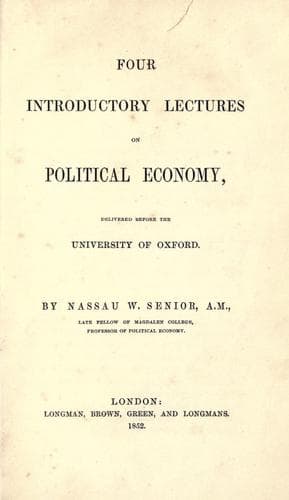
Four Introductory Lectures on Political EconomySenior, Nassau William
General
Four Introductory Lectures on Political Economy
Senior, Nassau William
Economics
Mr. Ricardo is, however, an exception. His great work is little less
scientific than that of Turgot. His abstinence from precept, and even
from illustrations drawn from real life, is the more remarkable, as
the subject of his treatise is distribution, the most practical branch
of Political Economy, and taxation, the most practical branch of
distribution.
The modern economists of France, Germany, Spain, Italy, and America, so
far as I am acquainted with their works, all treat Political Economy as
an art.
Many of them complain of what they call the abstractions of the English
school, and others accuse it of narrow views, and of an exclusive
attention to wealth; criticisms which must arise from an opinion that
Political Economy is a branch of the art of government, and that its
business is to influence the conduct of a statesman, rather than to
extend the knowledge of a philosopher.
It appears, from this hasty sketch, that the term Political Economy has
not yet acquired a definite meaning, and that, whichever of the three
definitions I adopt, I shall be free from the accusation of having
unduly extended or narrowed the field of inquiry which the statute
founding this professorship has laid open to me.
There is much in favour of the third definition, that which defines
Political Economy as the art which teaches what production, distribution,
accumulation, and consumption of wealth is most conducive to the
happiness of mankind, and what are the habits and institutions most
favourable to that production, distribution, accumulation, and
consumption.
It raises the political economist to a commanding eminence. The most
extensive, though perhaps not the most important, portion of human
nature, lies within his horizon.
The possession of wealth is the great object of human desire, its
production is the great purpose of human exertion. The modes and the
degree in which it is distributed, accumulated, and consumed, occasion
the principal differences between nations. The philosopher who could
teach such an art, would stand at the head of the benefactors of
mankind.
Public-domain text, read in full here on John Shaqi.
Reviews
Reviews
No reviews yet
Be the first to share your thoughts on this work.
Join the Discussion
Join the discussion
Sign in to leave a comment or review.
Sign InorCreate an account