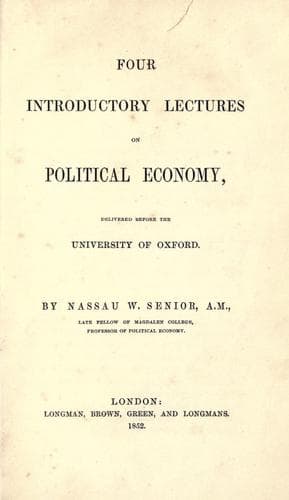
Four Introductory Lectures on Political EconomySenior, Nassau William
General
Four Introductory Lectures on Political Economy
Senior, Nassau William
Economics
But the subject is too vast for a single treatise, or indeed for a
single mind. This will be evident if we consider the extent of one
of its subordinate branches, the limits to be assigned to posthumous
power. On the death of a proprietor, ought his property to revert to
the state, as it does in Turkey, or to go to his children, as it does
in France, or to be subject to his disposition by deed or by will? If
it be subjected to his disposition, ought he to have merely the power
of appointing his immediate successors, or of entailing it for one
generation, or for two, or for ever? Is it advisable that he should
have the power, not only of appointing a successor to his property,
but of directing how that successor shall employ it? And ought such a
power to be unlimited, or to be confined to certain purposes, or within
a certain period? Ought the laws of succession and of testamentary
power to be the same as respects land and movables, or to differ
totally, or in any, or what, particulars? Ought these questions to be
resolved differently in an old country and in a colony, in a monarchy,
in an aristocracy, and in a republic? If Political Economy be a branch
of the art of government, these inquiries form a branch, though a very
small one, of Political Economy.
But there is scarcely any one of them which it would not require a
long treatise to answer satisfactorily. How many, for instance, are
the considerations which must be attended to in a discussion as to the
propriety of enabling individuals to found permanent institutions for
the purposes of religion, of education, and of charity, and as to the
period for which they ought to be allowed to govern them from the grave?
It is almost impossible to overrate the importance of the art of
government. With the exception, perhaps, of morality, it is the most
useful of the mental arts; but, with no exception whatever, it is the
most extensive. Too much attention cannot be given to it; but that
attention should be subdivided. Too many minds cannot be employed on
it, but each should select a single province; and the narrower the
province, of course the more completely is it likely to be mastered.
My second definition, that which defines Political Economy as the art
which teaches what are the institutions and habits most favourable to
the production and accumulation of wealth, is not liable to similar
objections. It opens a field of inquiry, positively indeed wide, but
comparatively narrow. The object proposed by the political economist is
no longer human happiness, but the attainment of one of the means of
human happiness, wealth.
Public-domain text, read in full here on John Shaqi.
Reviews
Reviews
No reviews yet
Be the first to share your thoughts on this work.
Join the Discussion
Join the discussion
Sign in to leave a comment or review.
Sign InorCreate an account