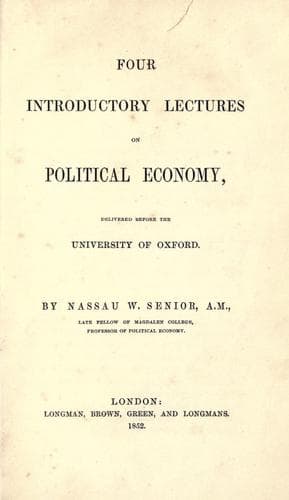
Four Introductory Lectures on Political EconomySenior, Nassau William
General
Four Introductory Lectures on Political Economy
Senior, Nassau William
Economics
To recur to my former illustrations, he must, as in the former case,
inquire whether, according to the principles of Political Economy,
individuals ought to be enabled to direct how the property which
they have acquired in life shall be employed after their deaths, in
providing religious teaching, and to what extent, and for what periods,
their posthumous legislation ought to be enforced; but he must stop far
short of the point to which his inquiries, if he had adopted the former
definition, would have extended. He must confine himself to the effect
of such institutions on the production and accumulation of wealth.
He has now no business to inquire whether endowments imply articles
of faith, and articles of faith produce indifference or hypocrisy;
whether the servility of a hierarchy be compensated by its loyalty, or
the turbulence of sectarianism by its independence of thought. He has
no longer to compare the moral and religious influence of an endowed,
with that of an unendowed clergy. He does not inquire whether the
morality of the one is likely to be ascetic, and that of the other
latitudinarian; whether the one will have more influence over the bulk
of the people, and the other over the educated classes; whether the
one is likely to produce numerous contending sects, animated by zeal,
but inflamed by intolerance, and the other an unreflecting apathetic
conformity. These are matters beyond his jurisdiction. But he assumes,
on the general principles of human nature, that every civilised society
requires teachers of religion, and that these teachers must be paid
for their services. He shows, on the principles of Political Economy,
that in every such society there are revenues derived from land or
from capital, which are consumed by a class not forced to take an
active part in producing them, and enjoying, therefore, a leisure which
they are tempted to waste in indolence or in frivolous occupation.
He shows that to dedicate a portion of these revenues to the payment
of the teachers of religion, is merely to substitute for a certain
number of lay landlords, or lay fundholders, bound to the performance
of no public duty, ecclesiastical fundholders, or ecclesiastical
landlords, rendering, in return for their incomes, services which,
under what is called the voluntary system, must be purchased by those
who require them. He shows that such a dedication must diminish the
number of idle persons, and therefore increase the productive activity
of the community and diminish the subjects of necessary expenditure,
and therefore increase its disposable income; and he infers that the
wealth of a society may be augmented by allowing such endowments to
be created. He may go on to show that such endowments may cease to be
favourable to wealth, if the founder’s legislative power be unlimited,
since the doctrines of which he has ordered the dissemination may have
been originally unpopular, or may become so as knowledge advances.
Public-domain text, read in full here on John Shaqi.
Reviews
Reviews
No reviews yet
Be the first to share your thoughts on this work.
Join the Discussion
Join the discussion
Sign in to leave a comment or review.
Sign InorCreate an account