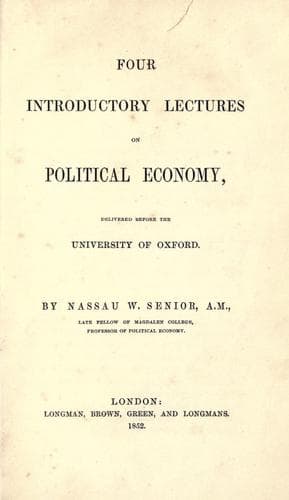
Four Introductory Lectures on Political EconomySenior, Nassau William
General
Four Introductory Lectures on Political Economy
Senior, Nassau William
Economics
The political economist, therefore, may recommend that all such
institutions be subjected to the control of the legislature, in order
to prevent endowments from being wasted by providing teachers for
whom there are no congregations, and that they be also subjected to
periodical revision, in order to accommodate the supply of instruction
to the demand.
He may proceed to consider the different forms of endowments, by
tithes, by land, by rent-charges, and by the investment of money. He
may show how the first is an obstacle to all improvement, and the
second to improvement by the landlord; how the third diminishes with
the progress of wealth, and the fourth may perish with the fund on
which it is secured. And he may propose remedies for these different
inconveniences. If he go further than this, he wanders from the art of
wealth into the art of government.
I have introduced this rather long illustration, not only as an example
of the different modes in which the _art_ of Political Economy must be
treated, according to the definition with which the teacher sets out,
but also as a specimen of the extent and variety of the details into
which he must enter, even if he adopt the less extensive definition.
But this is not all. I have already remarked that all the practical
arts draw their principles from sciences. If, however, the teacher
of an art were to attempt to teach also the different sciences on
which it is founded, his treatise would want unity of subject, and be
inconveniently long. He generally, therefore, assumes his scientific
principles as established, and refers to them as well known. The
teacher of the art of medicine merely alludes to the facts which form
the sciences of anatomy and chemistry; the teacher of rhetoric assumes
that his pupil is acquainted with the science of logic and with that
of grammar. Many of the sciences and of the arts which are subservient
to the art of Political Economy, may be thus treated. The political
economist, for instance, assumes that protection from domestic or
foreign violence or fraud, is essential to any considerable production
or accumulation of wealth, and he considers the means by which the
expense of providing this protection may be best supported; but he does
not inquire what are the necessary legal and military institutions.
He leaves these to be pointed out by the arts of war and of penal and
civil jurisprudence, and by the sciences on which those arts depend.
Public-domain text, read in full here on John Shaqi.
Reviews
Reviews
No reviews yet
Be the first to share your thoughts on this work.
Join the Discussion
Join the discussion
Sign in to leave a comment or review.
Sign InorCreate an account